Product details
Formulation
This is a flexible sheet barrier impregnated with deltamethrin. The APVMA classes it as a chemical in a non-soil matrix, but it is installed using the principles for sheet material barriers.
The sheet is a synthetic fibrous web about 2 mm thick, treated with deltamethrin. An orange 200 µm plastic membrane is laminated to the top and a black 50 µm LDPE layer to the bottom.
Poisons schedule: no poison schedule number has been allocated.
Overview
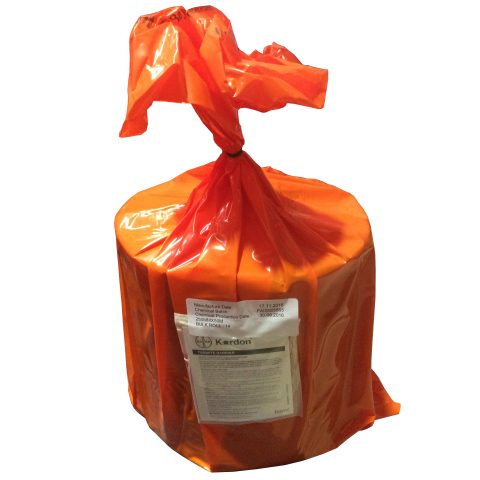
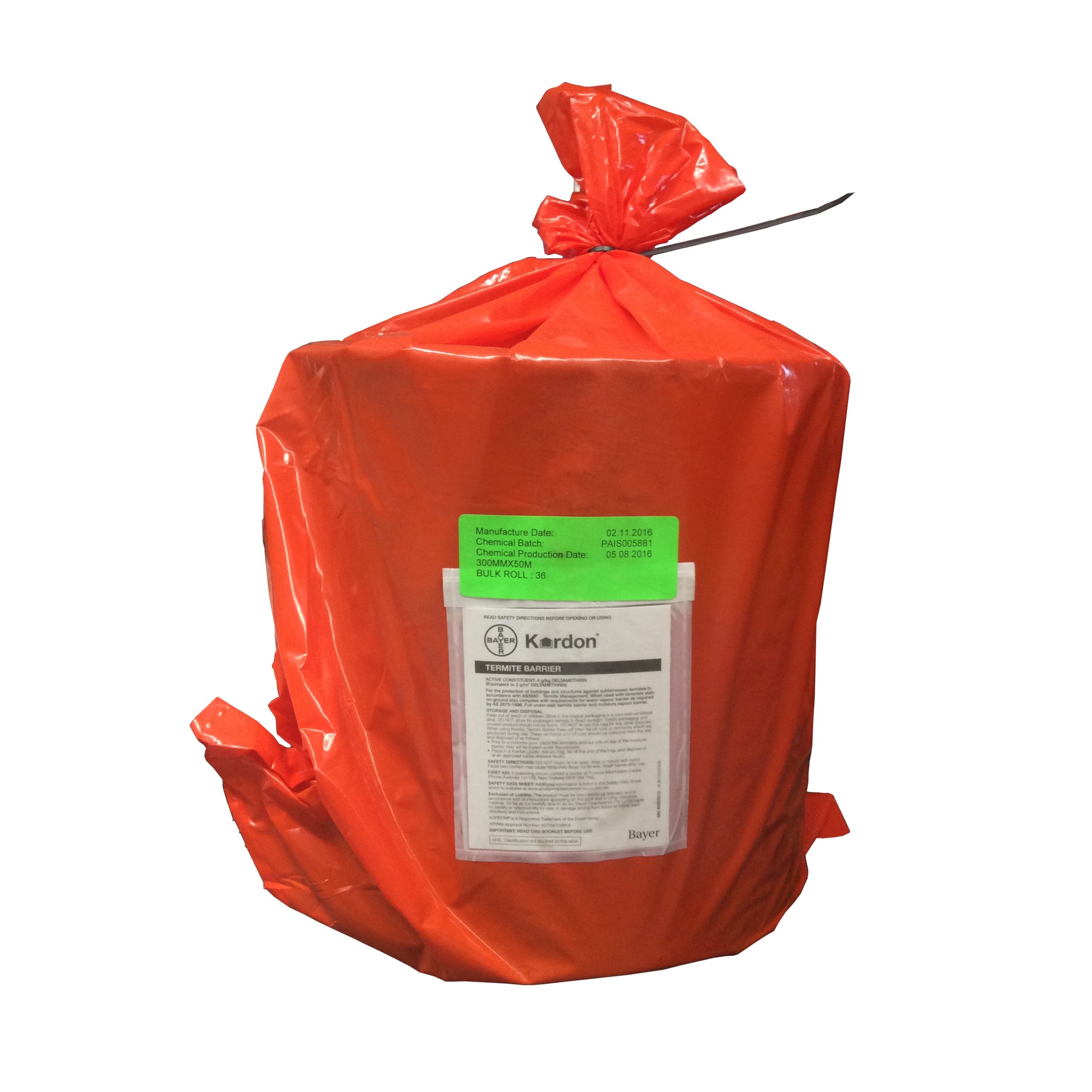
Kordon Termite Barrier 300 mm x 50 m is a physical termite barrier impregnated with deltamethrin. It is installed while a building is under construction to stop subterranean termites getting in unseen. It is designed to be squeezed between two building elements, which closes the hidden routes termites use, such as wall cavities, slab edges and gaps around pipes.
Deltamethrin repels termites, so they avoid the sheet. Instead they have to build visible mud tubes to get around it, and these show up at a routine timber pest inspection before serious damage is done.
This roll is 300 mm wide, which suits perimeter work, slab-edge rebates, in-fill slabs and service penetrations. The 300 mm width also matches the 300 mm x 300 mm patches the label requires when protecting penetrations by hand. It is installed to AS 3660.1 and the Building Code of Australia, and is registered with the APVMA (Approval Number 60759/52075).
Product Highlights
- Physical barrier and repellent in one sheet: no soil treatment is needed at the barrier line. The repellent keeps termites away from the sheet, and termites that try to go around it leave visible mud tubes.
- Long-term, durable protection: based on available data and ongoing field trials, it deters concealed termite entry for at least 20 years. The membrane is UV stabilised, and testing found no significant loss of deltamethrin after at least 3 months exposed on a concrete slab during construction.
- Suitable for low-allergen homes: testing showed the sheet gives off no respirable dust or volatile organic compounds, so it meets the requirements for building products used in low-allergen housing.
Target pests
- Subterranean termites: stops them entering buildings and structures unseen
Where to use
The label's Directions for Use cover all states except Tasmania.
- New building work
- Extensions and renovations
- Retaining walls and other construction situations that need termite protection or management
- Perimeter barriers for all construction types, including in-fill slabs and slab-edge rebates
- Service penetrations through concrete slabs
- Full under-slab system, where the sheet acts as both a termite barrier and a vapour barrier (when used with slab-on-ground it also meets AS 2870-1996 water vapour barrier requirements)
Application
Installers must complete Kordon Accreditation and Training and be assessed as competent in Unit 42A (Install Physical Termite Barriers). Before installing, inspect the site, remove stumps, roots, timber off-cuts and building waste from the building footprint, and eliminate any active nest within the property boundary up to 50 m from the new work. For detailed procedures, see the Kordon Installation Manual.
- Essential design rules: lay the black lower membrane facing the direction termites are expected to attack from (this may mean folding the sheet back on itself), and make sure the sheet is compressed between two building elements.
- Perimeter (slab-edge rebate): once the slab has cured, fix the sheet to the top of the slab edge with clouts or concrete nails. Run it across the cavity into the outer masonry wall so it finishes flush with the outside face.
- Perimeter (in-fill slab, before the pour): fix the sheet horizontally to the external brickwork, fold it back and secure it vertically to the inside of the brickwork using clouts plus a construction-grade adhesive.
- Joins and patches: overlap the sheets, tape with duct tape at least 30 mm wide, and bond with a construction-grade adhesive.
- Penetrations: if prefabricated Kordon collars cannot be used, cut 300 mm x 300 mm patches with a tight-fitting centre hole. Fit a 40 mm wide Kordon collar around each penetration and secure it with duct tape and cable ties.
- Leave at least 75 mm of ground clearance at the perimeter so inspectors can check for termites bridging the barrier.
- Fix a durable notice to the building as required by the Building Code of Australia.
- Equipment: duct tape (at least 30 mm wide), clouts or concrete nails, cable ties, and a construction-grade adhesive or bonding agent.
Safety
No signal heading. No poison schedule number has been allocated.
- Do not touch or rub your eyes, nose or mouth with your hands. Skin contact on the face may cause temporary facial numbness.
- Wash hands after use.
- The Safety Data Sheet specifies nitrile rubber gloves. Check the current SDS for full PPE details.
- Deltamethrin is dangerous to fish. Do not contaminate ponds, waterways or drains.
- Store in the original packaging in a cool, well-ventilated area. Do not store in direct sunlight for long periods.
- Do not burn packaging or product. Either place off-cuts on the moisture barrier before the concrete pour, or seal them in a Kordon delivery bag and take them to an approved waste facility.
- First aid: contact a doctor or the Poisons Information Centre on 13 11 26.
FAQ
- Is a 300 mm roll enough to protect a whole building? Not on its own. A perimeter barrier is a partial barrier. To comply with building regulations it must be used with other approved termite barrier systems under AS 3660.1. Where the slab forms part of the barrier, it must be poured and cured to AS 2870. For full under-slab coverage, the label lists wider rolls, up to 2400 mm.
- Can any Pest Management Professional install it, in any state? No. Installers must have Kordon Accreditation and Training and be assessed competent in Unit 42A (Install Physical Termite Barriers). The label's Directions for Use cover all states except Tasmania.
- Once Kordon is installed, are inspections still needed? Yes. Kordon deters concealed entry but does not stop termites bridging the barrier or getting in another way. Inspections should be done at least once a year, in line with the AS 3660 series and AS 4349.1. Keep the 75 mm minimum ground clearance at the perimeter so bridging can be seen, and protect the sheets from damage by other trades during construction.
Pack Size
- Single roll: 300 mm wide x 50 m long (15 m² coverage)
- Sheet thickness: fibrous web about 2 mm, laminated between a 200 µm top membrane and a 50 µm bottom membrane
- How to order: Garrards product code KORD/300