
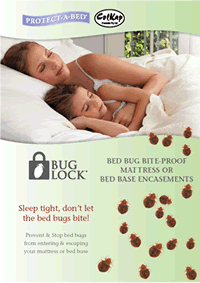
Bed bug mattress encasements are one of the most practical non-chemical tools a pest manager can add to a bed bug treatment. Protect-A-Bed mattress and bed base encasements with the BugLock zipper system are available to the Australian pest control industry through Garrards. They make treatments more effective, allow rooms to be re-occupied immediately and give your business an additional product to sell with every bed bug job.
The bed bug problem in Australia
Bed bugs (Cimex lectularius and the tropical species Cimex hemipterus) have resurged across Australia since the early 2000s. Hotels, motels, hostels, student accommodation, aged-care facilities and rental housing are the most frequently affected, but no home is immune. Bed bugs are hitchhikers, travelling in luggage, second-hand furniture and bedding, so any property can pick them up.
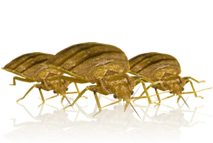
Several biological traits make bed bugs difficult to eliminate:
- Widespread resistance to many commonly used insecticides, which is why non-chemical methods are central to modern treatment.
- Females lay eggs continually through adult life, so small numbers quickly become a large infestation.
- Adults survive many months without a blood meal, waiting in seams, cracks and voids.
- They are cryptic and nocturnal, so infestations are often well established before anyone notices.
Identifying a bed bug infestation
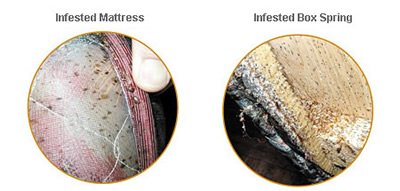
The first sign is usually bites: itchy, raised red welts in clusters or a line, easily mistaken for mosquito bites or a rash. Bites alone are not proof, so inspect mattress seams, piping and labels, the bed base or ensemble, the bed head and nearby furniture, skirting and fittings. Look for small brown or near-black faecal spots, shed skins, eggs, red smears from crushed bugs and live insects.
Where encasements fit in an IPM bed bug program
Eradicating an established infestation takes an integrated approach: thorough inspection, vacuuming, steam, targeted APVMA-registered insecticides where appropriate, and follow-up inspections. Mattress and base encasements support each step.
- Cuts off the harbourage. Bugs already inside the mattress or base are sealed in and cannot reach a host, so they eventually die without further treatment of the mattress itself.
- Keeps new bugs out. An encased mattress cannot be re-infested internally, avoiding mattress disposal.
- Makes monitoring easier. Bugs are forced onto the outer surface where they and their faecal spots are easy to see at follow-up.
- Limits spread. Encasing beds in adjoining rooms reduces the risk of the infestation moving through a property.
- Allows immediate re-occupation. Rooms return to service straight after treatment.
Encasements do not eliminate an infestation on their own, because bed bugs also harbour in furniture, fittings and the building structure. Use them as part of a full treatment program and leave them in place, unopened. Not all encasements are equal: a product must be laboratory certified as bed bug entry, escape and bite proof.
The Protect-A-Bed BugLock system

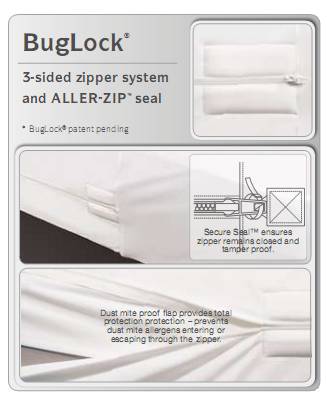
Protect-A-Bed encasements are certified by an entomology laboratory to be bed bug entry, escape and bite proof. The BugLock three-sided zipper uses micro-zipper teeth that bed bugs cannot weave through when closed.
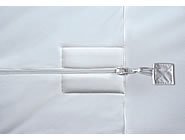
The weak point of any zippered encasement is the zipper end, where the slider often cannot fully close against the end stop. Secure Seal addresses this with a stitched safety trench, padded beneath the end stop, that bugs cannot pass even if the slider pulls away, plus a zip tie that fixes the slider to a tie-down point so the zipper cannot work open.
The Protect-A-Bed range available from Garrards
Alongside the standard BugLock encasement, the AllerZip range offers the same bed bug protection with a waterproof, breathable barrier that also protects against moisture, stains, dust mites and allergens.
AllerZip Terry mattress protector
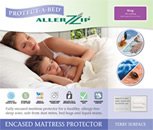
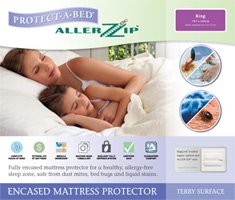
- Certified by an entomology laboratory to be bed bug proof
- Breathable, waterproof and absorbent, with superior protection against bed wetting
- Dust mite barrier and protection against allergens such as pet dander, pollen and mould
- 100% cotton terry sleeping surface, cool and comfortable
- BugLock three-sided zipper and AllerZip seal

AllerZip Smooth mattress protector
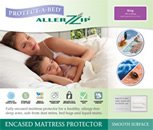
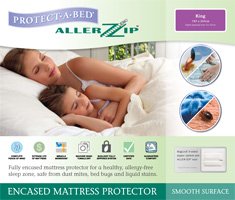
AllerZip Smooth offers the same certified bed bug, moisture and allergen protection as the Terry version with a smooth surface finish.
AllerZip mattress base protector
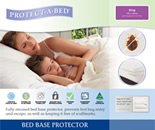
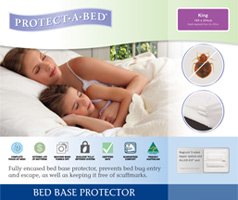
A fully encased bed base protector with BugLock that prevents bed bug entry and escape and keeps the base free of scuff marks. Machine washable hot, tumble dry medium. Use it with an AllerZip mattress protector, because bed bugs harbour in the base at least as often as in the mattress.
Sizes
| Size | Dimensions |
|---|---|
| Single | 92 x 188 cm |
| Extra Long Single | 92 x 204 cm |
| King Single | 107 x 204 cm |
| Double | 138 x 188 cm |
| Queen | 152 x 204 cm |
| King | 183 x 204 cm |
Mattress and base protectors share the same size range. Measure the bed before ordering.
Fitting and post-treatment procedure
- Inspect and treat the mattress and base (vacuum, steam or approved insecticide as per label) before fitting.
- Fit the encasement following the Protect-A-Bed fitting instructions, close the zipper fully and secure the zip tie.
- Fit the base protector as well; treating only the mattress leaves the most common harbourage unprotected.
- Advise the customer not to remove the encasement. Bedding and conventional protectors go over the top and are laundered as normal.
- Re-inspect at the follow-up visit; any live bugs will be on the outer surface.
Encasements are a natural add-on to every bed bug treatment and a preventive sale to accommodation providers, property managers and aged-care operators. Supplying and fitting them reduces callbacks and positions your business as offering a complete solution rather than a spray-only service.
Safety and compliance
Encasements are a non-chemical control. Any insecticide used in the same treatment must be APVMA-registered, applied strictly according to the label and only by a pest manager licensed in the relevant state or territory. Treatments should follow the Australian industry code of practice for bed bug control, which recognises encasements as part of an integrated program.
Downloads
- Protect-A-Bed BugLock brochure (PDF)
- BugLock fitting instructions (PDF)
- Recommended pre- and post-treatment procedures by Protect-A-Bed (PDF, 2.7 MB)
Frequently asked questions
Do mattress encasements kill bed bugs?
Bugs sealed inside an encasement cannot feed and will eventually die, but encasements do not treat bugs elsewhere in the room. They are a barrier and monitoring tool used alongside a full treatment.
How long should the encasement stay on?
Leave it fitted permanently. Opening it early can release surviving bugs. Protect-A-Bed’s post-treatment procedure document sets out the recommended approach.
Can a normal mattress protector do the same job?
No. Standard protectors cover only the top and sides and have no sealed zipper, so bugs move freely in and out. Only a fully sealed encasement that is laboratory certified as entry, escape and bite proof is suitable.
Available from Garrards
Protect-A-Bed BugLock and AllerZip mattress and base encasements are stocked by Garrards branches across Australia. For current sizes, pricing and volume orders, contact your nearest branch.
Contact your local Garrards branch
Frequently asked questions
Do mattress encasements kill bed bugs?
Bugs sealed inside an encasement cannot feed and will eventually die, but encasements do not treat bugs elsewhere in the room. They are a barrier and monitoring tool used alongside a full treatment.
How long should the encasement stay on?
Leave it fitted permanently. Opening it early can release surviving bugs. Protect-A-Bed’s post-treatment procedure document sets out the recommended approach.
Can a normal mattress protector do the same job?
No. Standard protectors cover only the top and sides and have no sealed zipper, so bugs move freely in and out. Only a fully sealed encasement that is laboratory certified as entry, escape and bite proof is suitable.