
Product details
Formulation
This is an emulsifiable concentrate (EC) that you dilute in water to make a spray emulsion. It is a Group 3A insecticide (synthetic pyrethroid).
Overview
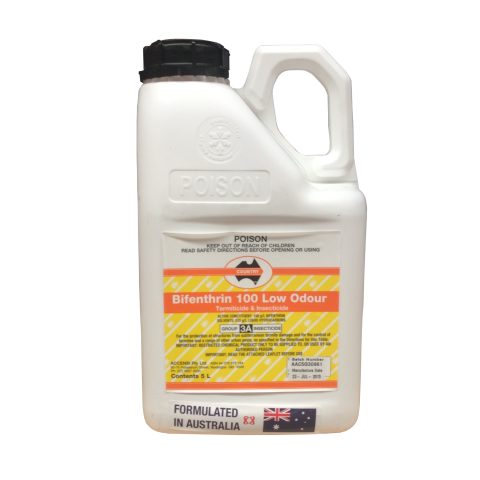
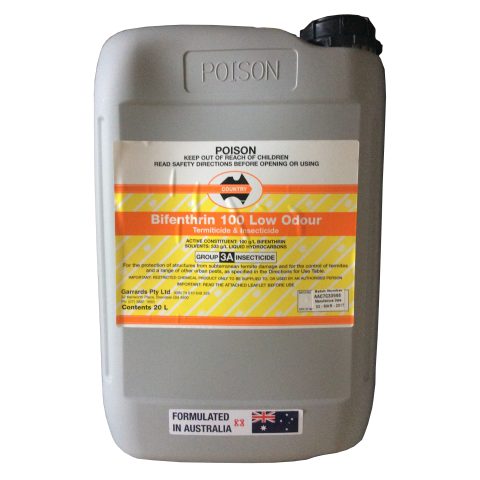
Biflex Ultra Lo-Odour Termiticide & Insecticide is a 100 g/L bifenthrin concentrate. It has two jobs: protecting structures from subterranean termite damage, and controlling a range of urban pests inside and outside buildings. Pest Management Professionals can install a termite barrier and carry out a general pest treatment with the same product.
For termites, the diluted emulsion is worked into the soil to form a continuous chemical barrier between the building and the termite colony. All work must follow the Australian Standard AS 3660 Series. The barrier is designed to stop termites getting into the building unseen. The manufacturer says the product both kills and repels subterranean termites.
For general pests, it gives knockdown and residual control of ants, cockroaches, spiders, fleas, flies, mosquitoes, ticks and paper nest wasps. Pests die from direct contact with the spray and from walking on treated surfaces later. The product is registered with the APVMA (Approval No. 59269/108187).
Product Highlights
- One concentrate for two kinds of work: termite barriers (pre-construction, post-construction, perimeter and reticulation) and general pest control on domestic, commercial, public and industrial sites. That means fewer products to stock in the vehicle.
- Works with certified reticulation systems for perimeter, service penetration, cavity infill and footing barriers. Barriers can be topped up through the system without trenching or drilling again.
- Long expected protection periods: up to at least 10 years south of the Tropic of Capricorn (Tasmania excluded) and up to 5 years north of it. Actual protection depends on the rate used, termite hazard, climate and soil. The lo-odour EC formulation is described by the manufacturer as non-staining, which helps when treating occupied homes.
Target pests
- Subterranean termites, including nest eradication (all states except Tasmania)
- Spiders
- Paper nest wasps
- Ants
- Cockroaches
- Fleas
- Flies
- Mosquitoes
- Ticks, adults and nymphs (does not include the paralysis tick, Ixodes holocyclus)
Where to use
General pests: inside and outside, in and around domestic, commercial, public and industrial buildings and structures, in all states.
Subterranean termites: domestic, public, commercial and industrial areas, in all states except Tasmania.
- Pre-construction barriers under slabs and under suspended floors with less than 400 mm crawl space
- Perimeter barriers for new and existing buildings
- Post-construction barriers under slabs and suspended floors, including injection through drilled concrete
- Certified reticulation systems for perimeter and service penetration treatment
- Certified reticulation systems for cavity infill and footing barriers
- Protection of service poles, fence posts and establishing trees, including fruit trees that are not yet bearing fruit
- Eradication of termite nests in trees, poles, posts and stumps
- Do not use in cavity walls, except through certified cavity infill reticulation systems or by treating a nest directly
- Do not use to treat mature trees or fruit-bearing trees
Application
Add the product to water in the spray tank and mix thoroughly. Keep the tank agitated during mixing and application. Follow the label for rates, emulsion volumes, rod spacings and hole spacings for each situation and region.
- Termite barriers: install according to the AS 3660 Series as horizontal and vertical barriers that are continuous, with no gaps. Methods include open wand spraying, trenching and treating the backfill, soil rodding, sub-slab injection and certified reticulation systems.
- Horizontal barriers: use low-pressure, high-volume equipment that delivers large, coarse droplets to reduce drift. A marker dye is recommended for even coverage, and a soil surfactant can help on hard-to-wet soils.
- Sub-slab injection: inject through pre-drilled holes using leak-free equipment with tip shut-off. Lateral dispersion tips are recommended. Reseal the drill holes afterwards.
- Physical barriers: chemical and physical barriers can be combined, but each certified system must be installed to its own specification and the AS 3660 Series.
- General pests: apply as a coarse, low-pressure surface spray, and do not go past the point of run-off. Use a solid stream nozzle for crack and crevice work. For spiders, use a two-part treatment: crack and crevice first, then an overall band spray.
- Do not apply to soil that is very wet or straight after heavy rain. Do not use as a space spray.
- Inspect at least once a year (more often in high-risk termite areas), as set out in AS 4349.3. The durable notice required by the BCA must state that the barrier has a finite life and that annual inspections are recommended.
Safety
POISON (Schedule 6). Restricted chemical product: it may only be supplied to, or used by, an authorised person. The applicator must be licensed under state legislation. Poisonous if swallowed. Will damage eyes and will irritate the skin.
- Opening the container and preparing spray: cotton overalls buttoned to the neck and wrist, washable hat, elbow-length chemical-resistant gloves, face shield or goggles, and chemical-resistant footwear
- Using the prepared spray: cotton overalls, washable hat, elbow-length chemical-resistant gloves and chemical-resistant footwear
- Enclosed areas: all of the above plus a half-face respirator with a combined dust and gas cartridge
- Re-entry: no entry to treated areas until the spray has dried, unless wearing cotton overalls and elbow-length chemical-resistant gloves
- Before spraying, remove pets and animals, cover or remove food and water containers, and cover fish ponds and aquariums
- Dangerous to fish and aquatic organisms. Do not contaminate waterways.
- First aid: Poisons Information Centre, 13 11 26
FAQ
- Can I buy and use it without a licence? No. This is a restricted chemical product. It is only supplied to, or used by, authorised persons, and the applicator must hold a state pest control licence.
- Does it work with reticulation systems and physical barriers? Yes, as long as the reticulation system is certified and can deliver the emulsion as required by the label and the AS 3660 Series. It is labelled for perimeter, service penetration, cavity infill and footing reticulation. It can also be combined with a certified physical barrier if each system is installed to its own specification.
- What are the main limitations? Termite use is not registered in Tasmania. Tick control does not include the paralysis tick. It is non-systemic, so it cannot protect mature trees or fruit-bearing trees. Existing poles and posts cannot be fully protected from attack below the treated zone. As a Group 3A insecticide, rotate with other modes of action where resistance is a risk.
Pack Size
10 L
- How to order: Garrards product code BIF/ULTRA/10