
Biofilm is an Australian-owned and Australian-produced flexible termite management system designed to satisfy the requirements of AS 3660.1 (2014) and reduce the risk of undetected subterranean termite entry into buildings. Installed during construction, Biofilm combines a chemical barrier in a non-soil matrix with a physical barrier, giving builders and termite managers a once-only treatment intended to protect the building for its economic life.
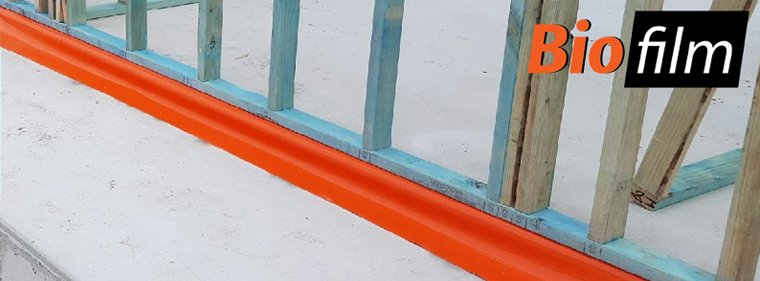
What is Biofilm?
Biofilm is a flexible sheet-type termite management system supplied on rolls. It is classed as a chemical barrier in a non-soil matrix, meaning the termiticide is carried within the material itself rather than being applied to the soil beneath and around the building. Because it is also a continuous physical membrane, it functions as a physical termite barrier as well, so it is best described as a combination system.
The product is installed while the building is being constructed, at the points where concealed termite entry is most likely. Once the slab is poured and the building is finished, the treatment is in place for the life of the structure and does not rely on periodic re-treatment of the surrounding soil.
Key features and benefits
- Designed to satisfy AS 3660.1 (2014), the Australian Standard for termite management in new building work.
- Deemed-to-satisfy the provisions of the Building Code of Australia Volume One and Volume Two (now part of the National Construction Code).
- Once-only treatment intended to protect from termite entry for the economic life of the building.
- Combination barrier: chemical barrier in a non-soil matrix plus a physical barrier in a single product.
- Flexible: conforms to slab edges, penetrations, cold joints and retaining walls where rigid products are difficult to fit.
- Proven efficacy when installed by suitably trained persons.
- Australian owned and produced, made for Australian termite species and construction methods.
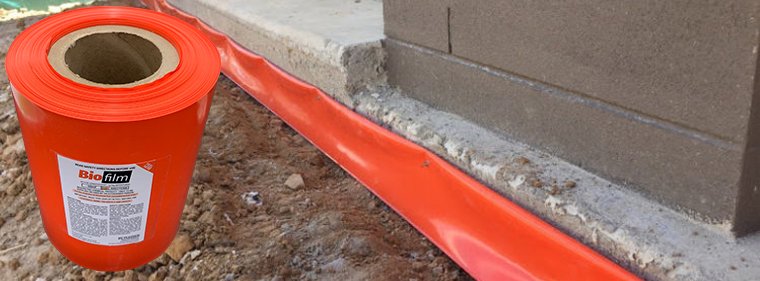
Where Biofilm is used
Biofilm is effective as:
- A perimeter treatment around the external edge of the slab, the most common route for concealed termite entry.
- A complete under-slab treatment where a full-coverage system is specified.
- Protection for retaining walls and cold joints, which are common weak points where concrete pours meet.
- Treatment of slab penetrations such as plumbing and electrical services passing through the slab.
Because it can be used at slab penetrations as well as the perimeter and under-slab areas, Biofilm can be installed as a complete stand-alone system to protect a building from termite entry, or combined with other management measures as the building design requires.
Sizes available
| Width | Roll length |
|---|---|
| 200 mm | 50 m |
| 250 mm | 50 m |
| 300 mm | 50 m |
Why termite management during construction matters in Australia
Subterranean termites are found across mainland Australia, and the economically important species, including Coptotermes acinaciformis, Schedorhinotermes species, Nasutitermes species and, in the tropical north, Mastotermes darwiniensis, enter buildings from the soil through concealed routes: the gap between a slab edge and the wall, cracks and joints in the concrete, and the annulus around pipes and conduits passing through the slab. Once inside a wall cavity they can cause extensive damage before any sign is visible.
The National Construction Code requires new buildings in termite-prone areas to have a termite management system, and AS 3660.1 sets out the recognised methods: physical barriers, chemical barriers, and combinations of the two. Systems installed during construction are far more effective and less disruptive than trying to retrofit protection to a finished building, which is why the choice of system is made at the design and slab stage.
Installation and documentation
- Biofilm should be installed only by suitably trained installers, in accordance with the manufacturer’s installation instructions and AS 3660.1.
- Installation is coordinated with the builder so that perimeter, penetration and joint treatments are in place before the relevant concrete pours and wall construction.
- AS 3660.1 requires a durable notice to be fixed in a prominent location, such as the meter box, recording the type of system, the date of installation, the installer and the recommended inspection frequency.
- Installers should provide the builder and owner with a certificate of installation for the building file and any council or certifier requirements.
How Biofilm fits into an ongoing termite management program
A termite management system installed during construction reduces the risk of concealed entry; it does not make a building immune to termites. AS 3660.2 recommends regular inspections by a licensed termite inspector, at least annually and more frequently in high-risk areas, so that any bridging or breaching of the system, such as garden beds built up above the slab edge, is identified early. Owners should also be advised to keep the slab edge exposed, manage moisture and avoid storing timber against the building.
Safety and compliance
- Termite management products are registered with the APVMA and must be installed in accordance with the approved label and the manufacturer’s instructions.
- Installers must hold the relevant pest management or termite management licence for their state or territory, and some jurisdictions require specific accreditation for pre-construction systems.
- Read the Safety Data Sheet and wear the personal protective equipment specified before handling and cutting the product.
- Retain installation records as required by your state regulator and the building certifier.
Frequently asked questions
Is Biofilm a physical or chemical termite barrier?
Both. Biofilm is classed as a chemical barrier in a non-soil matrix and is also a physical termite barrier, so it is a combination system under AS 3660.1.
Can Biofilm be used on an existing building?
Biofilm is designed to be installed during construction. For existing buildings, talk to your Garrards branch about post-construction termite management options.
Does a building with Biofilm still need termite inspections?
Yes. AS 3660.2 recommends regular inspections, at least every 12 months, for all buildings regardless of the termite management system installed.
Learn more
Available from Garrards
Biofilm is available from Garrards branches across Australia in 200 mm, 250 mm and 300 mm widths. Our branch staff can advise on roll quantities for a given slab design, installation training and complementary termite management products.
Contact your local Garrards branch
Frequently asked questions
Is Biofilm a physical or chemical termite barrier?
Both. Biofilm is classed as a chemical barrier in a non-soil matrix and is also a physical termite barrier, so it is a combination system under AS 3660.1.
Can Biofilm be used on an existing building?
Biofilm is designed to be installed during construction. For existing buildings, talk to your Garrards branch about post-construction termite management options.
Does a building with Biofilm still need termite inspections?
Yes. AS 3660.2 recommends regular inspections, at least every 12 months, for all buildings regardless of the termite management system installed.