
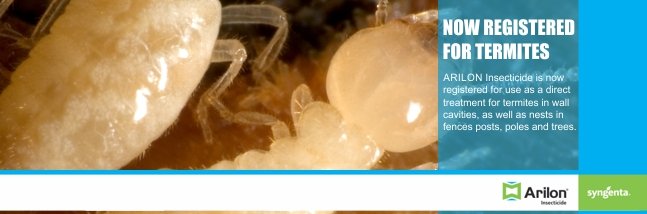
Syngenta’s Arilon insecticide is registered for use as a direct treatment for termites in wall cavities, and for nests in fence posts, poles and trees. Arilon termite treatment uses the same non-repellent water dispersible granule (WDG) that pest managers already carry for cockroach and ant work: mixed with water, it can be sprayed, dripped or foamed into termite workings and nests.

What the termite registration covers
- Direct treatment of termites in wall cavities of buildings.
- Treatment of termite nests in fence posts, poles and trees.
- Application methods: spray, drip or foam into termite workings and nests.
- Rate: 4.5 g of Arilon per 1 L of water.
- Situations: no restrictions on where it can be used – inside the property, outside and in the garden.
Why Arilon suits direct termite treatment
Transfer through the colony
Arilon has an exceptional ability to transfer through communal insect colonies, and many pest managers report excellent colony control for ants and cockroaches. The same mode of action now applies to active termites. Syngenta technical manager Dick Murray explained: “We treat a small number of termites directly at a number of active areas and rely on the ability of the termites to transport the toxicant through the colony, eliminating termites from structures.” Delayed mortality is the key – treated termites survive long enough to return to the nest and contact nest mates.
Economical and convenient
At 4.5 g per litre, Arilon is a very economical product for treating active termites. Because the termite registration was added to the existing Arilon label, pest managers can treat termites directly with the product they already use for cockroach and ant control, indoors and out, without changing products part-way through a job. Syngenta business manager Paul Jackson noted that this reduces the need to carry another product on the truck, saving time and money.
Arilon at a glance
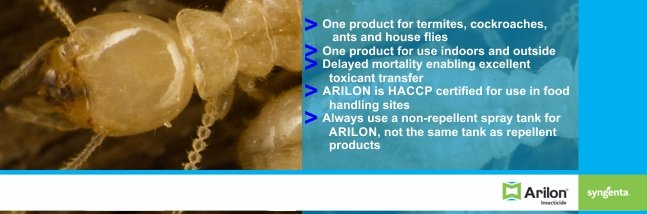
- One product for termites, cockroaches, ants and house flies.
- One product for use indoors and outside.
- Non-repellent, with delayed mortality enabling excellent toxicant transfer.
- HACCP certified for use in food handling sites.
- Available in 200 g and 500 g packs.
Important: Arilon is not a soil barrier
Despite its ability to spread through termite colonies, Arilon must not be used as an in-ground soil treated zone. The chemistry does not bind to soil for any significant period, so it cannot provide the lasting protection a treated zone requires under AS 3660.2. The recommended approach is to use Arilon first as a direct treatment of active workings, then follow up with an Altriset termiticide treated zone for total colony control and ongoing structural protection.
Step-by-step: direct treatment of active termites with Arilon
- Inspect and locate activity. Identify active workings in wall cavities, and nests in posts, poles or trees. Confirm the species where possible – direct treatment relies on workers carrying the toxicant home, so target areas with strong worker traffic.
- Choose the application method. Foam is ideal for wall cavities and voids where liquid would run away from the workings; drip or spray suits accessible mudding, galleries and nest material.
- Mix at 4.5 g/L in a dedicated non-repellent spray tank – never in a tank previously used for repellent products, as residues can deter termites and defeat the treatment.
- Treat a number of active points rather than saturating one, to maximise the number of termites that contact the product and carry it to the colony.
- Avoid unnecessary disturbance so termites continue to move through treated areas.
- Follow up with an inspection to confirm activity has ceased, then install an Altriset treated zone to protect the structure and complete colony control.
- Document the treatment, product, rate and locations, and issue the client with the required records and durable notice.
Safety and compliance
- Arilon is an APVMA-registered product; use only as directed on the label, which is available from Syngenta Australia (www.syngenta.com.au) for use with existing stock.
- Wear the PPE specified on the label and Safety Data Sheet when mixing and applying, and take care with foam and spray in confined wall cavities.
- Termite work must be carried out by a licensed pest management technician with the appropriate termite endorsement in your state or territory.
Available from Garrards
Arilon is available in 200 g and 500 g packs from Garrards branches, along with foaming equipment, non-repellent spray tanks and Altriset termiticide for follow-up treated zones. Contact your local branch for technical advice and details of foaming training.
Contact your local Garrards branch
Frequently asked questions
What is the Arilon rate for termites?
4.5 g of Arilon per 1 L of water, applied by spray, drip or foam into termite workings and nests. Always confirm the rate on the current label.
Can Arilon be used as a termite soil barrier?
No. Arilon does not bind to soil for long enough to act as a treated zone. Use it as a direct treatment and follow up with an Altriset treated zone.
Can I mix Arilon in my regular spray tank?
Use a dedicated non-repellent tank. Residues of repellent products can deter termites and reduce the effectiveness of the treatment.