Product details
Formulation
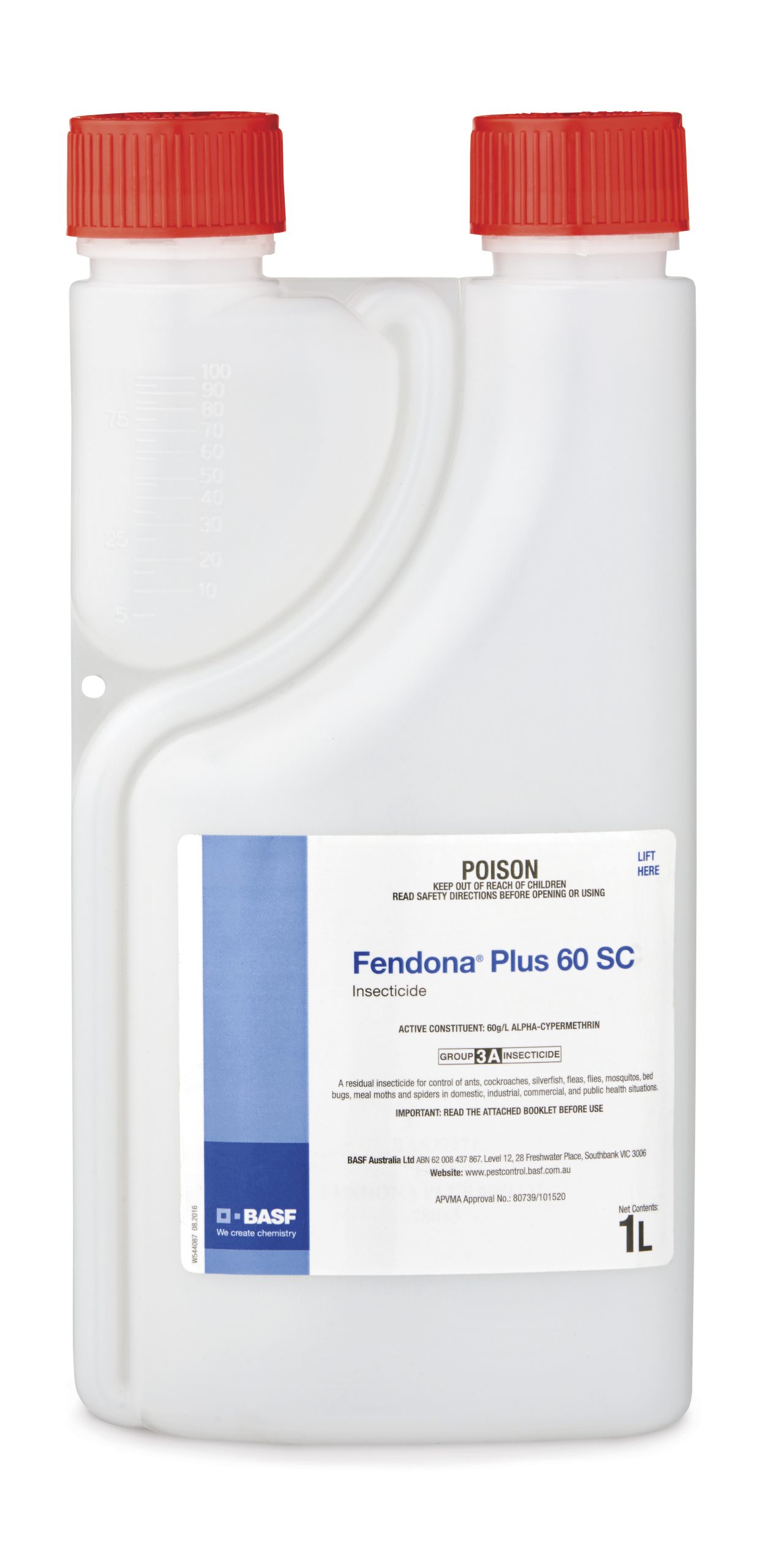
Suspension concentrate (SC), diluted in water before use. It is a Group 3A insecticide (synthetic pyrethroid) and is APVMA registered under product number 80739.
Overview
Fendona Plus 60 SC is a residual surface spray from BASF. Pest Management Professionals use it to control crawling and flying insects in domestic, industrial, commercial and public health situations. It is also registered to control litter beetles in poultry sheds.
It kills insects by both contact and ingestion. Applied as a surface spray, it has long residual activity, so treated surfaces keep working after the spray has dried. BASF says its microscopic particles stick well to surfaces and leave an odourless finish.
One concentrate covers ants, cockroaches, spiders, silverfish, fleas, flies, mosquitoes, bed bugs and Indian meal moth. This means a single product can handle most general pest jobs, from homes and restaurants to factories, ships and hospitals.
Product Highlights
- Broad label in one pack: covers crawling and flying pests, bed bugs and Indian meal moth in buildings, plus litter beetles in poultry sheds. That means fewer products to carry in the vehicle.
- Contact plus ingestion action with long residual activity: pests that touch or pick up the dried deposit are controlled. This supports maintenance programs as well as initial clean-outs.
- Labelled for sensitive sites: food processing establishments, restaurants, schools, hospitals and private houses are all listed use situations. The label describes it as relatively low in toxicity to humans and other animals and suitable for domestic and public areas.
Target pests
- Ants
- Cockroaches
- Spiders
- Silverfish
- Fleas (not for use on animals)
- Flies
- Mosquitoes
- Bed bugs
- Indian meal moth
- Litter beetles (poultry sheds)
Where to use
- Domestic, industrial, commercial and public buildings, and around agricultural buildings
- Food processing establishments, shops and restaurants
- Factories, ships, offices, schools and store rooms
- Hospitals, barracks and private houses
- External areas associated with these establishments
- Poultry sheds, for litter beetles only, when litter is being totally replaced
Application
Dilute with water and apply as a surface treatment with conventional public health spray equipment. Spray only to the point of run-off. Refer to the label for rates and application volumes.
- Crawling insects: coarse, low-pressure spray to areas pests frequent, especially cracks, crevices and infested areas.
- Flying insects: fine spray to wet surfaces where flies and mosquitoes rest.
- Spiders: spray spiders, webs and hiding places directly. Leave treated webs in place for at least 72 hours, then remove them.
- Bed bugs: treat bed frames, behind bed heads, bedside tables, cupboards, cracks, crevices, carpet edges and skirting boards. Mattress edges and seams may be treated, but never the surface people sleep on. Use an IPM approach and refer to the Code of Practice for the Control of Bed Bug Infestations in Australia.
- Indian meal moth: remove food, animal feed and containers first, then treat areas where pests are present.
- Poultry sheds: remove birds and remove or cover feed and water troughs. Remove old litter, then treat walls, ceiling and floor. Do not replace litter until the shed is thoroughly dry.
- Hard-to-wet surfaces: a registered non-ionic surfactant may be added. Very absorbent surfaces may need a higher water volume.
- Mixing: shake or invert the container, half-fill the tank with water, measure the concentrate with a graduated cylinder, top up and agitate thoroughly. Do not store diluted spray, and clean the sprayer after use.
- Do not apply with foggers, misting equipment, aerosol-generating equipment or sprayers carried on the user's back.
Safety
Signal heading: POISON (Schedule 6, SUSMP). Harmful if swallowed. Facial skin contact may cause temporary facial numbness.
- PPE when opening, mixing and spraying: cotton overalls buttoned to the neck and wrist (or equivalent clothing) and elbow-length chemical-resistant gloves.
- Re-entry: do not enter treated areas until the spray has dried. If earlier entry is needed, wear cotton overalls, a washable hat and elbow-length PVC gloves.
- Before treating, remove or cover exposed food, dishes, utensils and food preparation areas. Ventilate and clean up thoroughly before food processing or serving resumes. Cover or remove bird cages and fish tanks.
- Dangerous to fish and very toxic to aquatic life. Do not contaminate ponds, waterways or drains.
- Do not spray livestock or near livestock food or water.
- First aid: Poisons Information Centre 13 11 26. BASF emergency advice: 1800 803 440 (24 hours).
FAQ
- Can it be used in commercial kitchens and food plants? Yes. Food processing establishments, shops and restaurants are listed use situations. Remove or cover all exposed food, utensils and preparation surfaces before treating, then ventilate and clean thoroughly before operations resume. Where spraying a cockroach harbourage is not suitable, the label suggests a registered cockroach gel such as Goliath Gel or Amdro Gel.
- Can I use my backpack sprayer or fogger? No. The label prohibits fogging, misting and any aerosol-generating equipment, as well as sprayers carried on the user's back. It is a surface treatment for conventional public health spray equipment only.
- Will it work where pyrethroids have been used heavily? It is a Group 3A insecticide, and insect populations can contain resistant individuals that become dominant with repeated Group 3A use. Rotate with products from other mode-of-action groups and combine with IPM, especially for bed bugs and cockroaches. It must not be used to treat fleas on animals.
Pack Size
1 L bottle. Approximate packed dimensions: 9 × 9 × 24 cm; weight 1.15 kg.
- How to order: Garrards product code FEND/60/1L