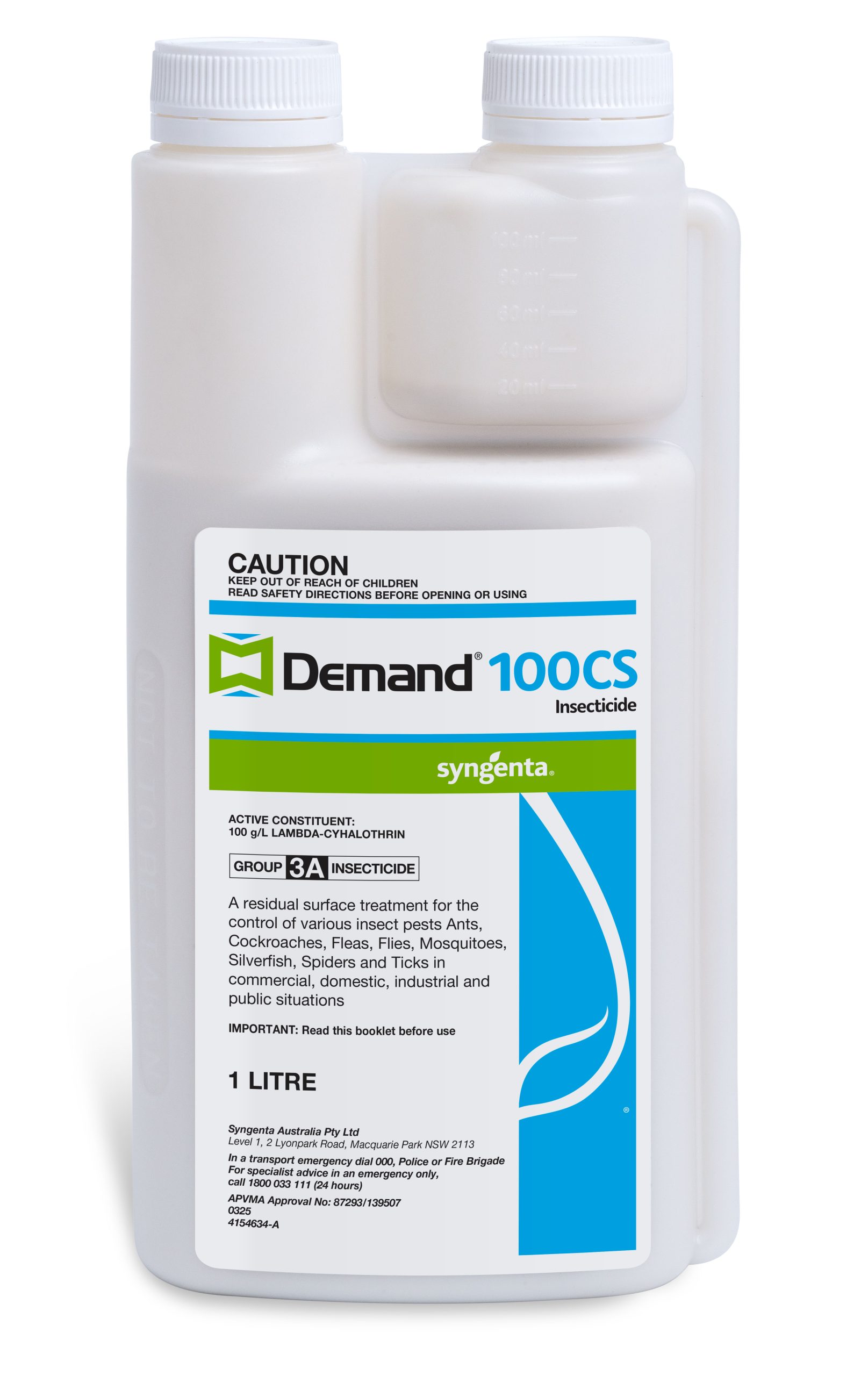
Product details
Formulation
Capsule suspension (CS). The lambda-cyhalothrin is held in polymer microcapsules suspended in water, using Syngenta's iCAP technology.
Group 3A insecticide (synthetic pyrethroid).
Overview
DEMAND 100CS Insecticide is a residual surface spray for Pest Management Professionals. It controls ants, cockroaches, fleas, flies, mosquitoes, silverfish, spiders and ticks in commercial, domestic, industrial and public situations. It is registered with the APVMA (Approval No. 87293/139507).
It covers most general pest service work with one concentrate. You can spray it on hard surfaces indoors and outdoors, use it as a barrier treatment around infestation points, and apply it to the vegetation around buildings to stop mosquitoes. In 2025 the label was extended to cover the Australian paralysis tick and the brown dog tick in outdoor areas.
The microcapsules protect the active ingredient on the treated surface. This gives residual control of up to 12 months indoors and up to 3 months outdoors for ants, cockroaches and house flies when applied at the label's higher rate. Longer residual means fewer callbacks and fewer re-treatments.
Product Highlights
- Long residual from microencapsulation: the iCAP polymer capsules protect the lambda-cyhalothrin on the surface. At the label's higher rate this gives up to 12 months' control of ants, cockroaches and house flies indoors and up to 3 months outdoors.
- Registered for mosquito treatment of vegetation: you can spray bushes, hedges, shrubs, ornamentals and leaf litter around buildings to create a perimeter barrier. This gives up to 14 weeks of mosquito control, with activity reducing over time.
- Suitable for sensitive indoor sites: it is water-based, low-odour, non-staining and HACCP certified. The label covers food processing and handling establishments, hospitals, schools, restaurants and transport equipment such as aircraft, buses, ships and trains.
Target pests
- Ants
- Cockroaches: American cockroach (Periplaneta americana) and German cockroach (Blattella germanica)
- Cat flea
- House flies
- Mosquitoes
- Spiders
- Silverfish
- Ticks: Australian paralysis tick (Ixodes holocyclus) and brown dog tick (Rhipicephalus sanguineus)
Where to use
Commercial, domestic, industrial and public buildings, including the outdoor and external areas that belong to them.
- Building types: barracks, factories, farm buildings, food processing and handling establishments, hospitals, hotels and motels, offices, residential homes, restaurants, schools, shops, storerooms and warehouses
- Transport equipment: aircraft, boats, buses, ships and trains
- Surfaces: cement (painted, unpainted and rendered), ceramic tiles, painted plasterboard, steel (stainless and enamelled), and wood (painted and unpainted)
- Vegetation (mosquitoes): bushes, hedges, leaf litter, ornamentals and shrubs, especially in shady, damp areas around buildings
- Outdoor areas (ticks): leaf litter, undergrowth, garden beds, pavers, paths, verandas, and the outside of commercial, domestic and public buildings and structures
- Do not use: on turf or lawns; on mud, sand, mangroves or aquatic habitats; or in farm buildings where grain or crop produce is stored
Application
Dilute with water and apply as a spray. Mix as follows: half-fill the spray tank with water, shake DEMAND 100CS well, add the measured dose, then top up with water. Close the sprayer, shake it, pressurise it and apply. Check the label for rates and spray volumes for each pest and situation.
- Crawling insects: find harbourages and treat them thoroughly with a coarse, low-pressure spray. Barrier spraying around the points where infestations start can improve control.
- Flying insects: apply as a residual surface treatment to indoor and outdoor areas where insects rest or harbour.
- Mosquitoes on vegetation: spray the vertical face of the outer edge of the vegetation, from the leaf litter at the base up to no more than 2 metres. Cover both leaf surfaces and get good penetration into the vegetation.
- Ticks: get good coverage of surfaces where ticks gather or have been seen.
- Do not apply by aircraft, or if heavy rain or storms are forecast within 3 days. Do not irrigate to the point of runoff for at least 3 days after application.
- Keep people and animals out of treated areas until the spray has dried.
Safety
Signal heading: CAUTION. Keep out of reach of children. Read the safety directions before opening or using.
The product may irritate the eyes and skin. Facial skin contact may cause temporary facial numbness.
- Wear the following when opening the container, preparing the spray and spraying: cotton overalls buttoned to the neck and wrist (or equivalent clothing) and elbow-length chemical-resistant gloves
- Wash your hands after use. Wash gloves and contaminated clothing after each day's use.
- Before treating, cover or remove all foodstuffs, dishes, utensils and food preparation surfaces, and take people and animals out of the area. Thoroughly ventilate treated areas afterwards.
- Very toxic to aquatic life: remove or cover fish tanks, and do not contaminate wetlands or watercourses
- Highly toxic to bees: do not spray while bees are actively foraging, and do not let spray drift onto nearby flowering plants
- First aid: Poisons Information Centre 131 126
FAQ
- Can I use it in kitchens and food premises? Yes. Food processing and handling establishments and restaurants are approved situations, and the product is HACCP certified. Cover or remove all food, utensils and food preparation surfaces before treating. Do not let the spray contact them, and clean up thoroughly before processing or serving resumes.
- Will it harm garden plants? Not all native species have been tested for phytotoxicity, so if you are concerned, treat a small area first. Do not use it on turf or lawns, and do not let spray drift onto flowering plants where bees may be foraging.
- Will cockroaches or other pests become resistant? It is a Group 3A pyrethroid, and resistant individuals can come to dominate a population if Group 3A products are used repeatedly. Rotate with insecticides from other mode-of-action groups as part of your resistance management. The label does not list any tank-mix partners, so check with Syngenta before mixing it with other products.
Pack Size
1 L
- How to order: Garrards product code DEMAND/100