
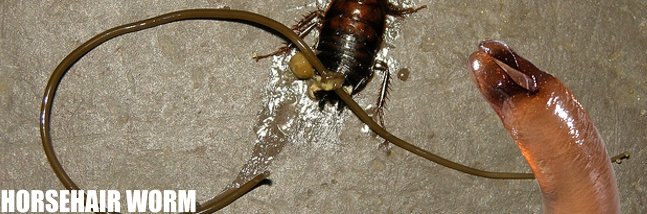
“I’ve got a German cockroach with a long worm coming out of it. Can you tell me what it is?” That question, from one of our customers, comes up more often than you might expect. The so-called cockroach worm is almost always a horsehair worm, also known as a Gordian worm: a parasite of insects and other invertebrates that is harmless to people, pets, livestock and plants, but a genuinely strange thing to find on a job.
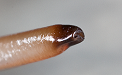
What is a horsehair worm?
Horsehair worms make up their own phylum, the Nematomorpha. They resemble nematodes (roundworms) but are a separate group, and they have been around for roughly 500 million years. The adults are very thin, no more than about 3 mm across, yet they can grow to a metre in length. The common name comes from an old belief that they were horse hairs that had fallen into water troughs and come to life.
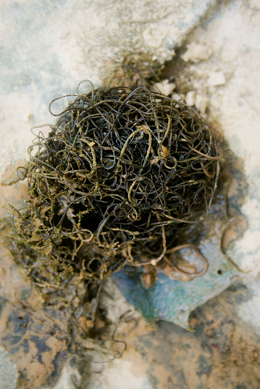
Adult horsehair worms are free-living and are most often found among vegetation at the edges of creeks, dams, ponds, pools and other wet areas. They move with a slow whipping action, and their most distinctive habit is to coil and wrap themselves into tight knots. That habit gives them their other name, the Gordian worm, after the legendary Gordian knot.
Life cycle: how a worm ends up inside a cockroach
- Eggs are laid in water. Adults mate in or near water and the female lays long strings of eggs.
- Larvae hatch and encyst. The tiny larvae form a protective covering, or cyst, and wait to be swallowed.
- A host eats the larva. When a suitable insect or other invertebrate takes in the cyst, whether directly from the water or by eating a smaller creature that carries it, the covering dissolves and the larva bores through the gut wall into the host’s body cavity. Typical hosts include grasshoppers, crickets, beetles, dragonflies, millipedes and, as in this case, cockroaches.
- The worm grows inside the host. It absorbs nutrients from the host’s body and can eventually take up most of the abdomen.
- The mature worm leaves. When ready to breed, the worm exits the host, often when the host is at or near water, to seek a mate and start the cycle again.
That final stage is what a pest manager sees: a live cockroach, or one that has just been knocked down by a treatment, with a long, thin, wriggling worm emerging from its body. It looks alarming, but the worm has simply been evicted from a host that is no longer viable.
Why it turns up on cockroach jobs
German cockroaches are the most common indoor cockroach pest in Australian kitchens, food premises and multi-unit housing, and they seek out moisture. A cockroach that drinks from standing water or eats an infected insect can pick up a horsehair worm larva. Because the worm needs water to complete its life cycle, seeing one indoors is a strong hint that there is a reliable water source nearby: a leaking pipe, a drain, a wet subfloor, a floor waste, or a garden pond or water feature just outside.
Is it harmful?
No. Horsehair worms do not parasitise humans, pets, livestock or plants, and they cannot survive inside warm-blooded animals. They pose no health risk, do not damage buildings or stock, and need no treatment of their own. Their presence simply indicates that invertebrates are active in the area and that there is water close by.
What it means for the pest manager
- Reassure the client. Explain that the worm is a parasite of the cockroach, not of people, and that it will die without a host.
- Treat the cockroaches, not the worm. Continue with your normal German cockroach program: thorough inspection, sanitation advice, harbourage reduction, gel baits and dusts placed in cracks and voids, and monitoring traps to confirm results. Use only APVMA-registered products according to their labels.
- Chase the moisture. The worm is a clue. Look for leaks under sinks and dishwashers, wet cabinets, condensation on refrigeration lines, blocked floor wastes and damp subfloors. Fixing moisture removes a resource the cockroaches depend on and improves the long-term result.
- Check outside. Ponds, water features, poorly drained gardens and leaking taps near the building can be both the source of the worm and a reservoir of cockroach pressure.
- Photograph and record it. A note and a photo in the service report help explain the finding to the client and to any technician who follows you.
Do not confuse it with these
- Nematodes. Much smaller and usually only visible under magnification. Some beneficial nematodes are sold as biological controls and look nothing like a horsehair worm to the naked eye.
- Fly larvae or maggots. Short, pale and segmented, and found in decaying material rather than emerging from a cockroach.
- Tapeworms. Flat and ribbon-like, and associated with vertebrate hosts, not cockroaches.
Frequently asked questions
Can a horsehair worm infect a person or a pet?
No. Horsehair worms only develop inside invertebrate hosts such as cockroaches, crickets and beetles. They are not a threat to humans, dogs, cats or livestock.
Do I need to treat for the worm?
No. There is no product for horsehair worms and none is needed. Once out of the host the worm needs water to survive and breed; indoors it will simply dry out and die.
Why would a German cockroach have one when they live indoors?
Cockroaches need water and will drink from any available source. A cockroach that drinks from contaminated water or eats another infected insect can pick up a larva. It is a sign to look for a moisture source in or around the premises.
Available from Garrards
Garrards stocks a full range of cockroach baits, dusts, sprays and monitoring traps for German cockroach programs, along with the inspection equipment you need to track down the moisture behind a stubborn infestation. Our branch staff are happy to help identify unusual finds like this one.
Contact your local Garrards branch
Frequently asked questions
Can a horsehair worm infect a person or a pet?
No. Horsehair worms only develop inside invertebrate hosts such as cockroaches, crickets and beetles. They are not a threat to humans, dogs, cats or livestock.
Do I need to treat for the worm?
No. There is no product for horsehair worms and none is needed. Once out of the host the worm needs water to survive and breed; indoors it will simply dry out and die.
Why would a German cockroach have one when they live indoors?
Cockroaches need water and will drink from any available source. A cockroach that drinks from contaminated water or eats another infected insect can pick up a larva. It is a sign to look for a moisture source in or around the premises.