
Stored product pests – grain beetles, weevils and pantry moths – regularly turn up in places Australian pest managers would never expect: bedrooms, briefcases, self-storage aisles and even inside rodent bait blocks. These three real cases from the Garrards Pest Review show why correct identification and a patient search for the source solve most “unusual” stored product pest problems.

The golden rule: find the source
When an unusual pest is encountered there is almost always a limited source – insects do not appear by spontaneous generation. Thorough investigation, combining inspection with careful questioning of the client, is usually needed to unearth it. Once the source is found and dealt with, the problem is normally solved. The cases below follow that pattern.

Case 1: Grain beetles in a bedroom and a briefcase
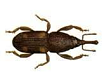
Two independent callers reported beetles in odd places: one brown and cylindrical, the other dark with four spots on the wings and a long snout. There was no food in the bedroom and the briefcase was empty.
Identification
The brown beetle was a flour beetle, Tribolium spp., which feeds on a wide range of grains, seeds, processed products, peanuts, cocoa beans, spices and dried fruit. The snouted beetle was a rice weevil, Sitophilus oryzae, which attacks only whole, undamaged grain. That narrows the search: what in a bedroom or a briefcase contains whole grain?
Answer
In both cases the source was a wheat bag used for pain relief. The bag had simply been taken out of the briefcase before the technician looked. Treatment: discard the infested wheat bag and treat the infested area.
Case 2: Beetles attacking rodent baits in a self-storage complex

The owners of a self-storage complex had tamper-resistant rodent bait stations placed through the common areas as a precaution, then found the baits themselves were being eaten by a beetle.
Identification
The culprit was the cigarette (tobacco) beetle, Lasioderma serricorne, which feeds on tobacco, rice, oilseed cake, herbs, cocoa, dried fruit, nuts, paprika and similar products – and readily on cereal-based rodent baits. The complication: each tenant holds the only key to their unit, so the source could not be inspected.
Answer
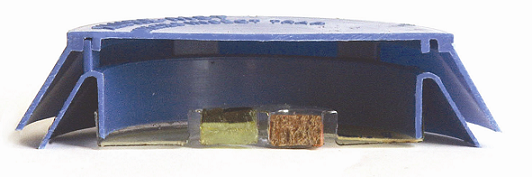
Because the source could not be located, all tenants were notified in writing to remove any potential food sources for the beetles. Pheromone traps (Multi Species Traps) were placed near the bait stations to catch male beetles, reducing breeding pressure and providing ongoing monitoring.
Case 3: Weevils in rodent baits at a north Queensland sugar mill

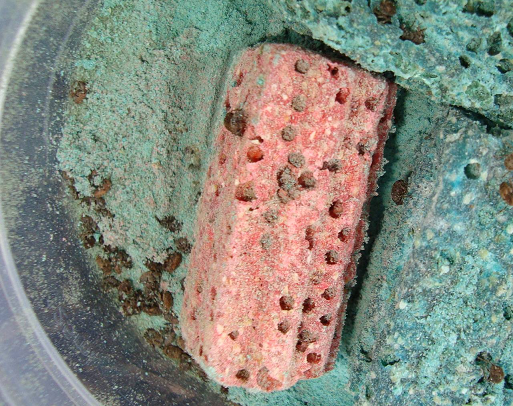
The caller described a small, fly-like insect with long legs that flew readily, eating rodent bait blocks “like nothing seen before” in huge numbers. A specimen was requested and arrived with hundreds of holes through the baits. It was a coffee bean weevil.
Identification
The coffee bean weevil damages maize, cocoa, coffee beans and dried fruit in tropical areas. Coffee is grown in the general region, so the obvious question was “is there coffee nearby?” The answer: no – but there was a cocoa processor next door.
Answer
Mill management was advised and the rodent baits were temporarily removed. The cocoa processor confirmed he had an infestation in his cocoa storage shed about a month earlier and had removed all the cocoa. With their primary food gone, the weevils moved to the rodent baits. The lesson: a potential repeat problem whenever cocoa is brought back into the store, so ongoing monitoring was recommended.
A procedure for unusual stored product pest jobs
- Get a specimen and identify it. A word picture over the phone is a start, but species-level identification tells you what the pest eats and therefore where to look.
- Question the client. Ask about food, pet food, seed, wheat bags, dried flowers, spices, neighbouring businesses and recent changes.
- Inspect thoroughly – including adjoining premises where access allows.
- Remove or treat the source. Discard infested material in sealed bags and treat the surrounding area as required.
- Monitor. Pheromone traps confirm the treatment worked and give early warning of re-infestation – especially where the source cannot be controlled, such as tenanted units.
- Protect rodent baits. Cereal-based baits are food to stored product pests; inspect stations regularly and replace damaged blocks.
Monitoring products for stored product pests
Garrards carries a range of ready-to-use pheromone monitoring devices for stored product pests.
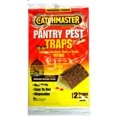
- Catchmaster Food & Pantry Moth Traps (2 pack, 21.6 cm x 13.3 cm) – for Indian meal moth, tobacco moth and Mediterranean flour moth. Place the enclosed pheromone square on the marked spot, fold the trap into a triangle and position it in cupboards where moths are seen. The wood-grain finish is discreet in domestic kitchens.
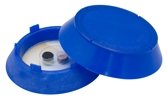
- XLure MST (and refills) – a multi-species beetle trap with a 360-degree entrance and beetle-specific pheromones that keeps working on dusty surfaces.
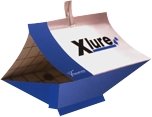
- XLure RTU – non-drying glue with high tolerance to dust particles, pre-loaded with Pherogel™ and disposable after use.
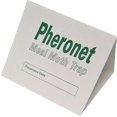
- Pheronet – simple to use and replace, ideal for monitoring Indian meal moth (Plodia interpunctella).
Safety and compliance
Pheromone traps are non-toxic monitoring tools, but any insecticide treatment of infested areas must use an APVMA-registered product applied according to its label, particularly in food-handling and food-storage premises. Pest management work is licensed at state and territory level, and commercial food clients will usually require treatment records and trap-catch data for their food safety program.
Available from Garrards
Catchmaster, XLure and Pheronet monitoring products, together with the wider range of stored product pest solutions, are available from Garrards branches across Australia.
Contact your local Garrards branch
Frequently asked questions
Why are beetles eating my rodent baits?
Most rodent baits are cereal-based, which makes them attractive food for stored product beetles such as the cigarette beetle and various weevils, especially when their normal food source has been removed.
What is the first step with an unusual stored product pest?
Obtain a specimen and identify it. Knowing the species tells you what it feeds on, which points you to the likely source.
Can pheromone traps control stored product pests on their own?
Pheromone traps mainly catch males and are primarily monitoring tools. They reduce breeding pressure but the infested source still has to be found and removed.