
Most fly jobs are routine, but every so often a fly control problem turns up that does not respond to the standard treatment. These three case studies, first published in the Garrards Pest Review, show how Australian pest managers traced unusual fly infestations back to their source in a hospital intensive care unit, a set of operating theatres and an upmarket restaurant. In every case the answer was the same: identify the fly, find where it is breeding, and treat the source rather than the adults.
A working procedure for unusual pest problems
Industry training increasingly focuses on demonstrating competency with the most common pests, so a repeatable procedure for the uncommon ones is a valuable part of any technician’s toolkit. A simplified version is:
- Record the customer’s information and the history of the complaint.
- Inspect thoroughly.
- Question the customer in more detail once you have seen the site.
- Identify the pest from specimens or evidence found.
- Find the source of the infestation.
- Check references and understand the pest’s life cycle and habits.
- Discuss the job with colleagues; it also organises your own thinking.
- Complete a risk assessment. Do not treat unless you have identified the cause.
- Select an appropriate treatment and never use a product off-label.
- Where applicable, involve the customer in the solution.
- Sub-contract to another pest manager if the job is beyond your capability.
When an unusual pest is encountered there is almost always a limited source. Insects do not appear by spontaneous generation, so thorough inspection and questioning will usually unearth where they are coming from. Once the source is found and dealt with, the problem is normally solved.
Case 1: Flesh flies in a hospital intensive care unit

Staff described a large fly with a grey and black striped thorax and a grey and black checkerboard abdomen. That is a textbook description of a flesh fly (Sarcophagidae), which deposits live maggots into decaying flesh; not a fly anyone wants in an ICU. The ICU windows did not open and the unit was separated from the outside by many doors, so the flies were not simply wandering in. The most probable source was a dead rodent or possum in the roof void, with the flies entering through air-conditioning or light fittings. The suspended ceiling meant the void could not be inspected directly.
The solution
A UV light glueboard unit was placed in the roof space above the ICU. Two days later the technician reported around a thousand flies on the board. The unit worked so well because it was the only light source in the roof void, and it also showed that only a small fraction of the flies breeding in the void were actually reaching the ICU. No insecticide was applied in the patient area.
Case 2: Phorid and vinegar flies throughout a hospital, including operating theatres
A different hospital and a very different problem: small flies were appearing throughout the building and surgeons refused to operate until it was resolved. The flies were identified as phorid flies and vinegar flies.

The phorid fly, also called the scuttle fly, has black eyes and a severely arched, hunch-backed profile because the head is tucked under the thorax. It is associated with advanced decaying organic matter and can lay eggs in open wounds, which makes it a genuine clinical risk. Heavy veins on the leading edge of the front wing, a flattened hind femur and a habit of running rapidly and erratically across surfaces instead of taking flight are the identifying features.

The vinegar fly (also called fruit fly or ferment fly) has distinctive large red eyes and a tan body with black stripes. Adults live about four weeks and females lay around 200 eggs, with a life cycle of 8 to 10 days. They breed in newly decaying fruit and vegetables, dirty mops, under bin liners, in recycling bins, floor drains and faeces, and are attracted to the sour odour of fermentation.
Inspection showed this was a refuse-management problem. Large unlined wheelie bins were used inside the hospital, wheeled out to a pen when full, emptied every second day and then returned inside without being washed. The liquid left in the bottom of each bin was a perfect vinegar fly breeding medium, and the “empty” bins carried flies to every part of the building. Bins in the pen were washed weekly, but any bin that happened to be in use on washing day could go months without cleaning.
The solution
The first objective was to get the theatres back in service. Sprays were not permitted, so all bins were removed and traps and sticky boards with wasp and fly attractant were placed throughout the theatres. The hospital was then advised to change its waste system: thorough wash-out of every bin and the use of bin liners. In similar hospital cases the major source has been sanitary bins in female toilets, where the fix is a more frequent change-over.
Case 3: Patrons demanding refunds because of flies on their food
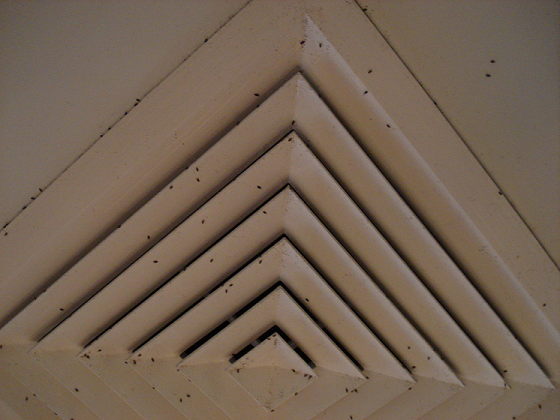
The owners of a six-month-old upmarket restaurant were losing money and reputation. Diners near the bar complained of flies landing on their meals and refused to pay. The flies had large red eyes, again the vinegar fly, and were massed on the air-conditioning vents above the bar and in the kitchen. Directly beneath both congregation points were floor drains.
The solution
Opening the drains revealed massive breeding areas in the organic sludge, with pupae visible under the lip of the kitchen drain, in a restaurant only six months old. A timed-release aerosol had been aimed directly at the flies above the bar, which is why the problem persisted: only the adults were being targeted. The drains were physically cleaned and then placed on a monthly treatment with a microbial drain product such as BioPlus or Drain Force to digest the organic build-up before it can support larvae.
Lessons for fly management
- Identify the species first. Flesh flies, phorid flies and vinegar flies each point to a different kind of source.
- Adult-only treatments (aerosols, space sprays) rarely solve a breeding problem; they buy time at best.
- In hospitals, food premises and other sensitive sites, non-chemical tools such as UV light traps, sticky boards and attractant traps are often the only options available inside the building.
- Sanitation recommendations (bin washing, liners, drain cleaning, sanitary bin frequency) are part of the treatment, not an afterthought. Put them in writing for the customer.
- Follow up. Monitoring with glueboards confirms whether the source has really been eliminated.
Frequently asked questions
How do I tell vinegar flies from phorid flies?
Vinegar flies have large red eyes and a tan, striped body and hover around fermenting material. Phorid flies have black eyes, a pronounced hump-backed shape and tend to scuttle across surfaces rather than fly when disturbed.
Why did the restaurant’s aerosol dispenser not work?
It was only killing adults. With the drains breeding new flies on an 8 to 10 day cycle, the population was replaced faster than the aerosol could remove it. Cleaning the drains removed the breeding medium.
Can I spray inside an operating theatre or ICU?
In practice, no. Hospitals will normally prohibit insecticide use in clinical areas. Use traps, sticky boards and light units, treat the source outside the clinical area, and work with the hospital’s infection control staff.
Available from Garrards
Garrards supplies UV light glueboard units, sticky boards and attractant traps for sensitive accounts, and microbial drain treatments such as BioPlus and Drain Force for ongoing drain fly control. Talk to your branch about the right combination for hospital, healthcare and hospitality sites.
Contact your local Garrards branch
Frequently asked questions
How do I tell vinegar flies from phorid flies?
Vinegar flies have large red eyes and a tan, striped body and hover around fermenting material. Phorid flies have black eyes, a pronounced hump-backed shape and tend to scuttle across surfaces rather than fly when disturbed.
Why did the restaurant's aerosol dispenser not work?
It was only killing adults. With the drains breeding new flies on an 8 to 10 day cycle, the population was replaced faster than the aerosol could remove it. Cleaning the drains removed the breeding medium.
Can I spray inside an operating theatre or ICU?
In practice, no. Hospitals will normally prohibit insecticide use in clinical areas. Use traps, sticky boards and light units, treat the source outside the clinical area, and work with the hospital’s infection control staff.