
Termidor ant control relies on two properties that set it apart from conventional sprays: it is non-repellent, and it has the Transfer Effect. Together these allow a single external treatment, applied by a licensed pest manager, to affect an entire ant colony rather than just the workers that were sprayed.
Ants as a pest in Australia
Ants are closely related to wasps and first appeared around 120 million years ago; they now occupy almost every habitat on Earth. Their success comes from social organisation, the ability to modify their environment and the ability to defend themselves. Colonies range from a handful of individuals to highly organised populations of millions that behave as a single unit, sometimes described as a superorganism.
When ants move into homes and businesses they become a nuisance pest, and some species are also a public-health concern or can short-circuit electrical equipment enough to cause fires. Their diversity and adaptability in the urban environment make ants one of the most common call-outs for Australian pest managers and one of the most frustrating problems for householders.
Why Termidor works on ants
Non-repellent
Termidor is non-repellent, so ants cannot detect it and do not react to it or avoid it. Ants on their routine trails to and from a building pick up Termidor as they cross the treated zone and carry it back through the colony.
The Transfer Effect
Because ants are social insects that feed and groom one another, Termidor spreads through the colony by contact. Ants that walk through a treated area carry Termidor on their bodies and pass it to nestmates they touch; those ants pass it on again. This Transfer Effect means whole populations are affected, including ants that never contacted the treated surface themselves.
Why treat outside?
After a thorough inspection, a pest manager will often recommend an external application of Termidor even when the ants of concern are inside. Many ants seen indoors are foraging back and forth from nests outside in search of food and water. Termidor is applied along the exterior foundation walls to create a treated zone of protection.
This is not a repellent barrier. Repellent barriers can actually trap ants inside a building. Because Termidor is undetectable, ants walk straight through the treated zone, which is exactly what is needed for the Transfer Effect to work.
Why professional application matters
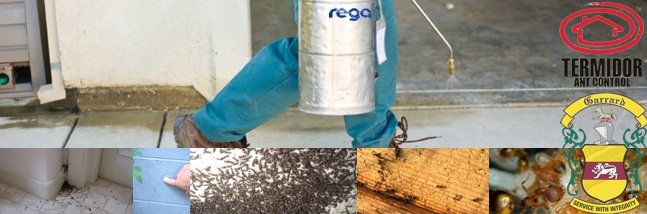
Do-it-yourself ant control can make an infestation worse. Over-the-counter sprays are repellent and can cause a phenomenon called budding, where ants cut off from the parent nest and queen establish new colonies. For effective ant control with Termidor, application should only be carried out by a licensed professional pest manager, following the label and the relevant state or territory licensing requirements. Termidor is a registered product and must be used as directed on the APVMA-approved label, with the PPE specified.
What householders can do
Professional treatment works best when the site is made less attractive to ants. Pest managers can pass on these simple steps to customers.
Inside
- Clean up spills and food crumbs quickly.
- Empty rubbish bins often.
- Dispose of uneaten pet food.
- Store food in pest-proof containers.
Outside
- Keep trees and shrubs trimmed back from the house.
- Keep gutters and stormwater drains free of debris.
- Watch for new ant mounds or nests around the home.
- Keep rubbish bags sealed and in closed bins.
Available from Garrards
Termidor is available to licensed pest managers from Garrards branches across Australia. Contact your local branch for pack sizes, current pricing and label information.
Contact your local Garrards branch
Frequently asked questions
Why is a non-repellent product better for ants?
Ants cannot detect a non-repellent treated zone, so they walk through it and carry the active back to the colony instead of being deflected or trapped inside the building.
What is the Transfer Effect?
Ants that contact Termidor carry it on their bodies and pass it to nestmates through feeding and grooming, so the whole colony is affected even if most ants never touched the treated surface.
What is ant budding?
Budding happens when repellent sprays separate part of a colony from the queen; the separated ants start new colonies, multiplying the problem.