
HomeGuard Precision Termite Management is a termite barrier system that combines a registered termiticide with a physical sheet, granule or collar, giving builders and pest managers a chemical barrier in a non-soil matrix. Registered by the Australian Pesticides and Veterinary Medicines Authority (APVMA), HomeGuard meets the performance appraisal requirements of the Building Code of Australia and is available from Garrards branches nationwide.

What HomeGuard is
HomeGuard is classified as a chemical termite barrier in a non-soil matrix. Instead of applying a liquid termiticide to soil, the active ingredient is distributed evenly through a polymer sheet, granule or rigid collar that is built into the slab and perimeter of the building. The result is a system that stops, kills and repels subterranean termites while also performing the job of a waterproof membrane or damp-proof course.
- A single sheet with the active ingredient evenly distributed throughout the matrix, so there are no gaps in the barrier
- Acts as a waterproof membrane, a damp-proof course (DPC) and a termite management tool in one product
- Does not leach or diffuse; the active is locked into the matrix for longevity and reduced environmental exposure
- Sealed permanently into the building so it cannot be disturbed after construction
- Patented design, described by the manufacturer as the first physical termite barrier registered by the APVMA
Why a physical-chemical barrier suits Australian conditions
Subterranean termites, particularly Coptotermes species, are the major timber pest in Australian housing and are active in every state and territory except Tasmania’s far south. Australian Standard AS 3660.1 requires new buildings in termite-prone areas to have a termite management system installed during construction, and the National Construction Code requires that system to be either a physical barrier, a chemical barrier or a combination of both.
HomeGuard is designed to satisfy that requirement in one installation. Because the termiticide is bound into the sheet, the barrier is not affected by the soil disturbance, moisture and landscaping changes that can compromise a conventional soil-applied chemical treatment, and because the sheet contains an active ingredient, termites that contact it are killed or repelled rather than simply redirected.
System components
The HomeGuard PTM system consists of five components that are used together to protect the slab, the perimeter cavity and every service penetration.
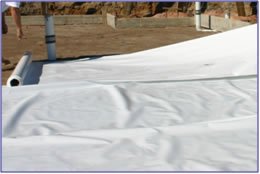
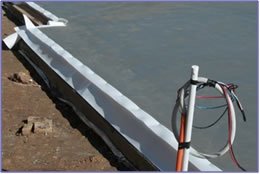
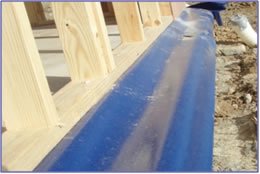
HomeGuard TMB (termite and moisture barrier)
HomeGuard TMB is the under-slab sheet. It complies with all requirements of Australian Standard AS 2870, so it doubles as a 0.2 mm high-impact moisture barrier. It is supplied in convenient 2 m wide rolls that unfold to cover a total area of 4 m x 50 m. At 0.2 mm the lightweight sheet is easy to carry, transport and lay.
HomeGuard DPC (damp-proof course)
HomeGuard DPC is a 1 m x 50 m roll of 0.5 mm sheet designed to be cut to size for the perimeter cavity. It complies with AS 2870 as an approved 0.5 mm damp-proof course, so no additional perimeter cavity DPC needs to be installed.
HomeGuard Blue
HomeGuard Blue is a cost-effective perimeter barrier. It does not comply with AS 2870 as a damp-proof course, so a separate DPC must be installed with it.
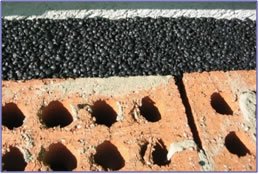
HomeGuard GT (granulated termite barrier)
HomeGuard GT is a proactive granulated termite barrier. It can be used for a full perimeter installation and is also well suited to corrective situations where a sheet product cannot be laid.
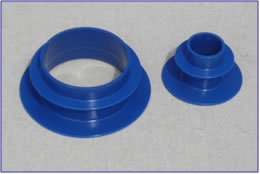
HomeGuard Collars
HomeGuard Collars are termiticide-impregnated service penetration collars that lock into the slab, even if installed incorrectly. Their patented rigid design makes them the only rigid penetration collar on the market that kills and repels termites as well as physically stopping their entry into the building. Collars come in a range of sizes to fit most pipe penetrations in a home and all comply with AS 2870.
Installer benefits
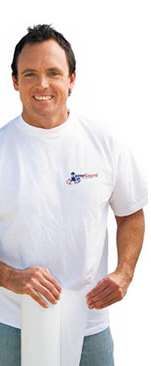
- Contains a UV stabiliser and will not delaminate
- No sharp edges, so you will not cut your hands as you can with some metal physical barrier systems
- Non-scheduled and non-sensitising, making it safer for installers and for the home owner
- White sheet shows chalk line markings clearly and reflects radiant heat, so it is cooler to work around
Field trials
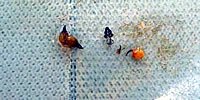
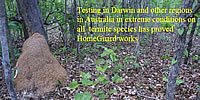
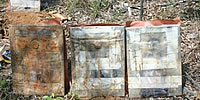
HomeGuard was extensively trialled before it was brought to market. The trial images show dead termite shells on a piece of HomeGuard, a trial site where the barrier was placed under high termite pressure and still performed, and Northern Territory trial plots comparing HomeGuard with ordinary plastic sheet to demonstrate its repellent effect. The active ingredient is the same as in the manufacturer’s Biflex liquid termiticide, which has a long history of Australian trials.
Compliance and safety
- Registered by the APVMA; always follow the approved label and the manufacturer’s installation instructions
- Meets the performance appraisal requirements of the Building Code of Australia and holds CSIRO building approval
- Suitable for use in all states of Australia
- Termite management systems in new construction must be installed to AS 3660.1 and certified by an accredited installer; check the licensing requirements of your state or territory
- A durable notice must be fixed in the meter box or similar location recording the system installed, and the owner should be advised to have inspections at least every 12 months in line with AS 3660.2
- Read the safety data sheet before handling and wear the personal protective equipment it specifies
Downloads

- HomeGuard TMB safety data sheet (PDF)
- HomeGuard DPC safety data sheet (PDF)
- HomeGuard Blue safety data sheet (PDF)
- HomeGuard Blue label (PDF)
- HomeGuard GT safety data sheet (PDF)
- HomeGuard Collars safety data sheet (PDF)
Frequently asked questions
Is HomeGuard a physical or a chemical termite barrier?
Both. It is registered as a chemical barrier in a non-soil matrix: the termiticide is locked into a physical sheet, granule or collar, so it physically blocks termites and kills or repels those that contact it.
Do I still need a separate damp-proof course?
Not with HomeGuard TMB or HomeGuard DPC, which both comply with AS 2870. HomeGuard Blue does not, so a separate DPC must be installed with it.
Can HomeGuard be used on existing homes?
The sheet products are designed for installation during construction. HomeGuard GT granules can be used for corrective work around existing structures; talk to your Garrards branch about the right component for the job.
Available from Garrards
Garrards stocks the full HomeGuard Precision Termite Management range, including TMB, DPC, Blue, GT and Collars, together with labels, safety data sheets and installation advice. Contact your local branch for pricing, availability and installer training.
Contact your local Garrards branch
Frequently asked questions
Is HomeGuard a physical or a chemical termite barrier?
Both. It is registered as a chemical barrier in a non-soil matrix: the termiticide is locked into a physical sheet, granule or collar, so it physically blocks termites and kills or repels those that contact it.
Do I still need a separate damp-proof course?
Not with HomeGuard TMB or HomeGuard DPC, which both comply with AS 2870. HomeGuard Blue does not, so a separate DPC must be installed with it.
Can HomeGuard be used on existing homes?
The sheet products are designed for installation during construction. HomeGuard GT granules can be used for corrective work around existing structures; talk to your Garrards branch about the right component for the job.