
Premise termiticide, whose active ingredient is imidacloprid, is a non-repellent product that exploits the social behaviour of subterranean termites. This article summarises a manufacturer research review by Dr Phil McNally, David Price and Karl Morris that examined whether termites exposed to a Premise-treated zone can carry a lethal dose back to nestmates that never contacted the treatment. The research was originally published by Bayer Environmental Science, whose professional business now trades as Envu.

Why termite social behaviour matters

A subterranean termite colony divides its work between castes: workers forage for food, reproductives produce young, and soldiers defend the nest. The castes are in constant close contact. Returning workers regurgitate food to soldiers, other workers and the developing brood (trophallaxis); workers groom one another to remove micro-organisms and contaminants; faeces are probed and consumed; and impaired or dead termites are probed and carried away from the heart of the nest.
These behaviours keep the colony healthy, but they are also its weak point. If a termiticide can be picked up by foraging workers without repelling or killing them immediately, the same grooming and feeding behaviour can spread it through the colony.
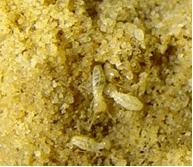
The transfer study
Method
- Subterranean termite workers were collected from the field and placed on soil treated with Premise at concentrations from 100 parts per million (ppm) down to 0.1 ppm. For reference, label-rate applications of Premise at 0.1% and 0.05% correspond to soil concentrations of about 100 ppm and 50 ppm respectively.
- Five exposed workers (donors), marked with blue dye, were left on the treated soil for one hour and then moved to untreated soil containing 100 termites that had never been exposed (recipients).
- Mortality was recorded daily for seven days.
Results
- After seven days, 100% of donors exposed at 100 ppm were dead; about 70% of donors exposed at 10 ppm and even 1 ppm had died.
- Donors exposed at 100 ppm transferred enough Premise to kill 95% of recipients, an outcome the manufacturer calls the “Domino Effect”.
- Donors exposed at only 1 ppm still transferred enough to kill 50% of recipients.
- Donors and recipients showed the same symptoms (immobility followed by death) at roughly the same time, even though donors were exposed 24 hours earlier. This short lag suggests the effect spreads through a colony quickly.
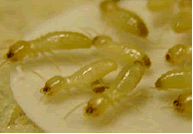
Beyond the treated zone
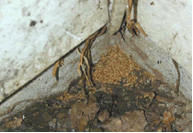
The researchers also asked how far an exposed worker could travel before symptoms stopped it. Donors exposed to 0.05% to 0.1% Premise remained symptom-free and fully mobile for between two hours and two days. Whatever distance a worker can cover in that window is the distance over which it can carry a lethal dose away from the treated zone. In field studies the authors observed aggregations of dead termites some distance (described as several feet, roughly a metre or more) from the treated zone.
What this means for Australian termite managers
- Non-repellent termiticides such as imidacloprid depend on termites entering the treated zone unhindered, so continuous, correctly applied treated zones matter more than with repellent products.
- The transfer effect helps explain why activity can decline in areas beyond the treated soil, but a treated zone is not a substitute for a full inspection, correct application and a monitoring program.
- Premise must be applied in accordance with its APVMA-approved label and the relevant Australian Standard for termite management in existing buildings, by a technician holding the appropriate state or territory licence.
About this research
This summary reflects manufacturer research published around 2005 and posted on the Garrards site in 2010. The mechanism is still widely cited, but refer to the current Premise label and Envu technical literature for present-day recommendations. The original article also promoted a manufacturer termite identification guide offer, which has expired.

Downloads
Available from Garrards
Premise and other non-repellent termiticides are available from Garrards branches nationally, along with technical support for termite inspection and treatment programs. Contact your local branch for current product information.
Contact your local Garrards branch
Frequently asked questions
What is the Premise transfer effect?
Termites that pass through Premise-treated soil pick up imidacloprid without being repelled and carry it back to the colony, where grooming and feeding spread a lethal dose to nestmates that never contacted the treatment.
Is this research current?
It is a manufacturer study from the mid-2000s. The mechanism it describes is well established, but current application advice should always come from the present APVMA-approved Premise label.