Product details
Formulation
Water-based liquid concentrate (a suspension) that you dilute in water before spraying or dipping.
Group 3A insecticide (synthetic pyrethroid).
Overview
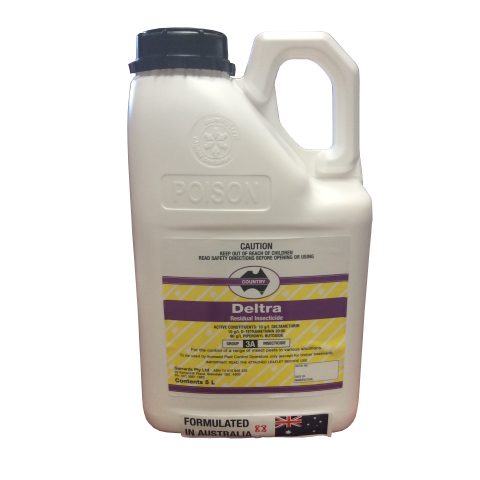
COUNTRY Deltamethrin 10 Residual Insecticide is an APVMA-registered concentrate containing 10 g/L deltamethrin, approval number 53349/2.5-10L/1007. Pest Management Professionals use it to leave a residual surface treatment that controls crawling, flying and stored product insect pests inside and around buildings.
One concentrate covers most general pest work. That includes cockroaches, ants, spiders, fleas, silverfish, bed bugs, bird mites, carpet beetles, clothes moths, mosquitoes, houseflies and stored product insects. It can be used in homes and in commercial, industrial and public buildings, including food processing establishments.
The label also covers some specialist uses. These are dipping export cut flowers for quarantine pests and short-term protection of freshly felled logs and sawn timber against bark beetles and borers.
Product Highlights
- Broad label in a single concentrate: it covers crawling insects, flying insects, bed bugs, bird mites, fabric pests and stored product insects. You can carry fewer products on the vehicle.
- Approved for food processing establishments, hospitals, schools and ships, with clear precautions on the label. This suits commercial accounts where you need a registered residual treatment.
- Uses beyond urban pest work: dipping export cut flowers for quarantine pests, and short-term protection of freshly felled pine logs, poles, posts and sawn timber, including timber already in place.
Target pests
- Cockroaches
- Ants
- Web-spinning spiders
- Non-web-spinning spiders
- Fleas
- Silverfish
- Bed bugs
- Bird mites
- Carpet beetles
- Clothes moths
- Mosquitoes
- Houseflies
- Stored product insect pests (beetles and adult moths)
- Quarantine pests on cut flowers for export
- Five-spined bark beetle (Ips grandicollis) on freshly felled pine logs
- Timber beetles of the families Anobiidae, Bostrychidae and Lyctidae (not in WA)
Where to use
- Domestic, commercial, industrial and public buildings, including food processing establishments, shops, factories, ships, offices, schools, storerooms, hospitals, barracks and private houses
- Outdoor areas around these buildings
- Cut flowers for export (dip treatment)
- Freshly felled pine logs before debarking (short-term protection)
- Freshly felled logs, poles, posts and sawn timber, including timber already in place (short-term protection; not in WA)
Application
This is a surface treatment only. Apply it as a coarse spray with a hand sprayer, knapsack or power sprayer, and don't spray past the point of run-off. The label gives different water volumes for non-porous surfaces and for porous surfaces or power equipment. Export cut flowers are fully dipped in the diluted product. Check the label for rates.
- Shake the container before use. Make a premix with an equal amount of water, add it to the tank, then top up. Agitate during application.
- Mix only what you need. Don't store diluted spray.
- Do not use foggers or any equipment that makes an aerosol.
- Do not spray outdoors if rain is imminent.
- Do not spray the moving parts of machinery, electric motors or switchgear.
- Cockroaches: treat known and likely harbourages, and spray a barrier where infestations may be coming from.
- Ants: spray directly into nest entrances and soak the nest. Wetting sandy or porous soil first helps the spray penetrate.
- Spiders: spray the spiders, their webs and hiding places. Leave webs in place for a few days afterwards.
- Fleas and carpet beetles: vacuum first, then lightly spray, focusing on areas under furniture and with little foot traffic.
- Bed bugs: treat the bed frame and nearby walls, cracks, crevices and skirting boards.
- Flies and mosquitoes: spray surfaces where they rest, including outside surfaces that get morning sun, walls, awnings, fences and vegetation near buildings.
- Carpets: spray a small hidden area first and let it dry to check for staining.
Safety
Signal heading: CAUTION, which is the Schedule 5 signal heading under the Poisons Standard (SUSMP). Keep out of reach of children.
- PPE when opening the container, mixing and spraying: cotton overalls buttoned to the neck and wrist, a washable hat, elbow-length PVC gloves and a face shield.
- Harmful if swallowed. Irritates the eyes and skin. Contact with facial skin may cause temporary numbness.
- Remove or cover exposed food, dishes and utensils before treatment. Ventilate and clean up thoroughly before food processing or serving starts again.
- Let the spray dry before handling treated materials such as cut flowers or sawn logs. If you must handle them earlier, wear chemical-resistant gloves.
- Dangerous to fish. Do not contaminate streams, rivers or waterways with the chemical or used containers.
- First aid: contact a doctor or the Poisons Information Centre on 13 11 26.
- Store in the closed original container in a cool, well-ventilated place, out of prolonged direct sunlight. The container is drumMUSTER eligible.
FAQ
- Can I use it in food premises? Yes. Food processing establishments and storerooms are listed use situations. Remove or cover exposed food and utensils first, and don't let spray touch food packaging. Let treated surfaces dry before putting food back, and avoid spraying surfaces that food will touch directly. Throw out any food that gets spray on it.
- Will it stain carpets or porous surfaces? Too much liquid on carpet can leave water stains. For carpet, the label recommends the non-porous (lower-volume) dilution where possible. Use the higher-volume dilution only for long-pile or shag carpet that needs deeper penetration. Spray a hidden test patch and let it dry first. Let treated carpet dry before people walk on it again.
- Will it get rid of all flying insects, and what about resistance? A residual surface spray only controls insects that land on treated surfaces. Insects flying in from untreated areas mean total elimination shouldn't be expected. Deltamethrin is a Group 3A insecticide, and repeated use of Group 3A products can lead to resistant populations, so rotate with other modes of action. Where a spray isn't suitable, the label points you to other registered products: a cockroach gel, a dust for roof voids where bird mites are a problem, and a pet flea treatment.
Pack Size
5 L
How to order: COUNT/DEL/5