
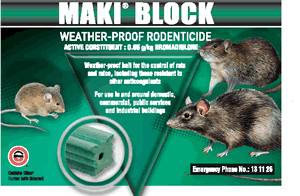
Maki Block is a 20 g bromadiolone rodenticide block from Liphatech, the company that developed and patented bromadiolone. It was the first Liphatech rodenticide introduced to Australia and is available from Garrards branches nationwide. Its extruded, weather-resistant matrix makes it a reliable everyday bait for maintenance and contract work in damp or hot conditions.

What it is
Maki Block is a 20 g block containing the anticoagulant bromadiolone, produced by a unique extrusion process that makes it both weather-resistant and palatable. The product is supplied in a 7.5 kg bucket and is registered for use against the three main commensal rodent species in Australia: the Norway rat (Rattus norvegicus), the roof rat (Rattus rattus) and the house mouse (Mus musculus).
Key attributes
High weather and mould resistance
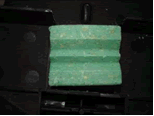
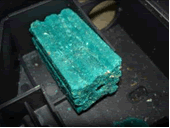
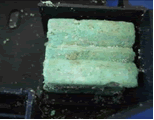
Liphatech tested Maki Block in a dairy factory under steady conditions of 15 degrees Celsius and 87 per cent humidity for three months. At the end of the trial Maki Block was free of mould or other degradation. The reference product tested alongside it showed mould after 36 days and was completely damaged at three months.
| Maki Block | Reference product | |
|---|---|---|
| Day 1 |
 |
 |
| After 3 months |
 |
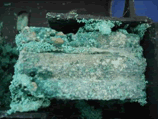 |
High melt resistance
Maki Block has been tested to 54 degrees Celsius without melting, which matters in roof voids, sheds and sun-exposed stations across much of Australia. At the time of the original launch, Liphatech reported that trials to determine the exact melting point were ongoing.
Strong palatability and efficacy
Weather resistance is Maki Block’s headline attribute, but the bait matrix is also formulated to be attractive and palatable to rodents so that uptake is reliable when rodents are present.
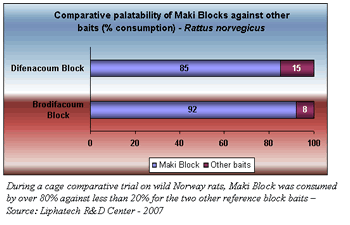
Bromadiolone: developed by Liphatech
Bromadiolone was developed and patented by Liphatech in 1976 and has been used in Australia for many years. It is a single-feed anticoagulant effective on both rats and mice. Combined with a suitable bait matrix, it is well suited to maintenance baiting programs.
When to use Maki Block
- Maintenance and contract jobs. Long-lasting performance gives confidence between visits when rodent activity is low, while palatability secures control when rodents arrive.
- Monthly or quarterly service schedules. The block holds up between infrequent visits.
- Harsh environments. Damp sites such as food factories, cool rooms and stormwater areas, and hot sites such as roof voids and outdoor stations.
Safety and compliance
- Maki Block is an APVMA-registered rodenticide. Read the label before use and apply only at label rates, in label situations.
- Place blocks in tamper-resistant bait stations secured out of reach of children, pets and non-target animals. Anticoagulant baits can cause secondary poisoning of predators and scavengers that eat poisoned rodents, so collect and dispose of carcasses at each service.
- Wear gloves when handling bait, and record placements on a site plan for audit and safety purposes.
- Rodenticides may only be applied commercially by licensed pest management technicians under state and territory legislation.
Downloads
The Safety Data Sheet and AQIS approval are available on request from your nearest Garrards branch.
Frequently asked questions
What is the active ingredient in Maki Block?
Bromadiolone, a single-feed anticoagulant developed by Liphatech.
Which rodents is Maki Block registered for?
Norway rats, roof rats and house mice.
Will Maki Block melt in a hot roof void?
It has been tested to 54 degrees Celsius without melting.
Available from Garrards
Maki Block is available from Garrards branches across Australia. Contact your branch for the current label, SDS, pack options and pricing.
Contact your local Garrards branch
Frequently asked questions
What is the active ingredient in Maki Block?
Bromadiolone, a single-feed anticoagulant developed by Liphatech.
Which rodents is Maki Block registered for?
Norway rats, roof rats and house mice.
Will Maki Block melt in a hot roof void?
It has been tested to 54 degrees Celsius without melting.