Product details
Formulation
- Formulation type: ready-to-use pelleted bait with a cereal base
- Chemical family: coumarin, a second-generation anticoagulant rodenticide (SGAR)
- Poisons schedule: Schedule 6, with the signal heading POISON
- Contains a bittering agent to deter people from eating it
Overview
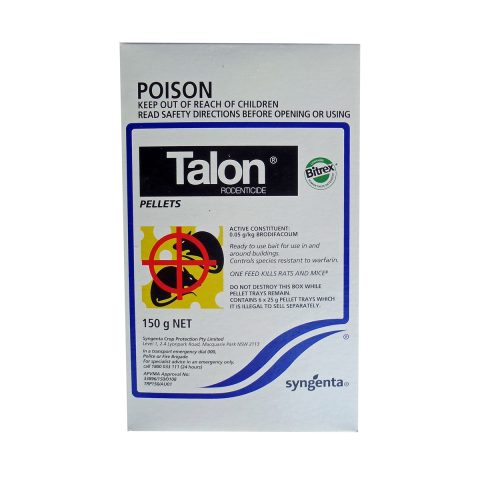
Talon Rat & Mouse Killer Pellets are a single-feed rodenticide for Pest Management Professionals controlling rats and mice in and around agricultural, commercial, domestic, industrial and public service buildings. The active is brodifacoum, a second-generation anticoagulant that stops the blood from clotting.
The pellets are made for jobs where earlier anticoagulants have stopped working. They kill rodents resistant to bromadiolone, coumatetralyl and warfarin. One feed gives a lethal dose, and most deaths occur 4 to 7 days after the rodent feeds.
The cereal pellet is designed to resemble the food most rat and mouse species prefer. The label supports both clean-out (pulse baiting) programs for active infestations and monitoring or maintenance programs at sensitive sites, such as food premises working under food safety audit requirements. APVMA approval number: 33896/105633.
Product Highlights
- Breaks resistance: kills rats and mice resistant to bromadiolone, coumatetralyl and warfarin. This gives you an option when a site has stopped responding to first-generation or less potent baits.
- One feed kills: a single feed is a lethal dose. Fewer feeds needed means fewer return visits to reach control, and the label allows a pulse-baiting schedule.
- Two program types on one label: you can run clean-out treatments for active infestations and monitoring or maintenance treatments where preventing rodents is essential, which suits audited food-safety sites. The built-in bittering agent adds a safeguard against people eating the bait by accident.
Target pests
- Rats, including rats resistant to bromadiolone, coumatetralyl and warfarin
- Mice, including mice resistant to bromadiolone, coumatetralyl and warfarin
Where to use
- In and around agricultural, commercial, domestic, industrial and public service buildings
- Use is restricted to areas in and around buildings (within 2 m) or enclosed spaces, such as drains
- In tamper-resistant bait stations placed under cover, never in the open
- Sensitive sites that need monitoring or maintenance baiting to prevent infestation, for example where a food safety audit requires it
- Not in places that pets, domestic animals, livestock or birds can reach
- Keep away from food, food utensils and areas where food is prepared or stored
- Using it to control protected native rodents or rodent-like animals requires permission from wildlife authorities
Application
Follow the label for bait station spacing, inspection intervals and how long to keep treating.
- Equipment: tamper-resistant bait stations, fixed securely with nails or wire where needed. Use a scoop or measure to handle pellets.
- Before baiting, remove other food sources as far as practical.
- Placement: put stations where rodents are active, along walls or rafters and in dark, sheltered spots, positioned so non-target animals can't get in.
- Clean-out (pulse baiting): treats existing infestations. Inspect and refill stations on the label schedule and replace spoiled or contaminated pellets. Stop treatment and remove stations once control is achieved, unless a maintenance program follows.
- Monitoring and maintenance: use in areas prone to infestation, with checks on an agreed and documented schedule. Switch to clean-out directions if rodents are found.
- Record the number and location of every station so it can be refilled and later removed.
- Check for pellets that rodents have dragged into the open.
- While baiting, actively search for dead and dying rodents and dispose of them as the label directs.
Safety
Signal heading: POISON (Schedule 6). Poisonous if swallowed.
- Don't touch the pellets. Use a scoop or measure.
- Don't breathe in the dust.
- If pellets touch your skin, and after every baiting, wash thoroughly with soap and water.
- The antidote is vitamin K1 (phytomenadione). If poisoning occurs, contact a doctor or the Poisons Information Centre on 131 126.
- Depending on how much is eaten, the bait may kill or injure dogs, cats, pigs, poultry and wildlife. Keep stations out of reach of children, pets, livestock and birds.
- Don't contaminate dams, waterways or drains with pellets or used containers.
- Store in the closed original container in a dry, cool, well-ventilated place out of direct sunlight.
- Don't burn empty containers or product. Dispose of them through an approved waste management facility.
FAQ
- Can I still buy and use Talon Pellets? From 24 March 2026, the APVMA suspended registration of second-generation anticoagulant rodenticides for 12 months, and this label approval (33896/105633) is on the suspended list. During the suspension, the product can only be held and used under the APVMA's published instructions, which override the label wherever they conflict. The APVMA has also certified that SGARs should be declared restricted chemical products, so access is moving to licensed pest controllers. Read the APVMA Gazette No. 5 (10 March 2026) instructions before you buy or use this product.
- Can I bait outdoors, along fence lines or at burrows away from buildings? No. Use is limited to in and around buildings (within 2 m) or enclosed spaces such as drains, always in tamper-resistant stations under cover and never in the open. For areas further out, or where non-target animals such as poultry, dogs or birds could reach the bait, choose another option that suits the site.
- Rodents are still taking bait. Does that mean it isn't working? Not necessarily. One feed is lethal, but deaths usually take 4 to 7 days, and rodents keep eating after they have taken a lethal dose. That is why the label uses pulse baiting with scheduled inspections rather than keeping stations constantly full. It is also why you need to search for and remove carcasses during treatment, to reduce the risk of secondary poisoning. Brodifacoum controls populations resistant to bromadiolone, coumatetralyl and warfarin.
Pack Size
1 kg
- How to order: Garrards product code TAL/1