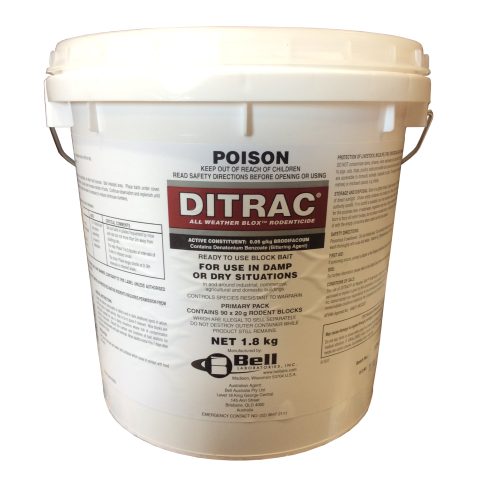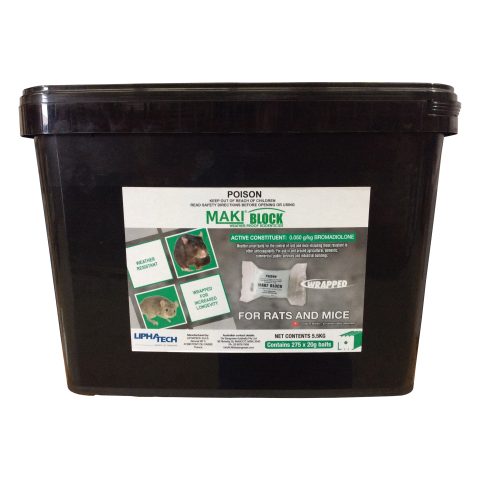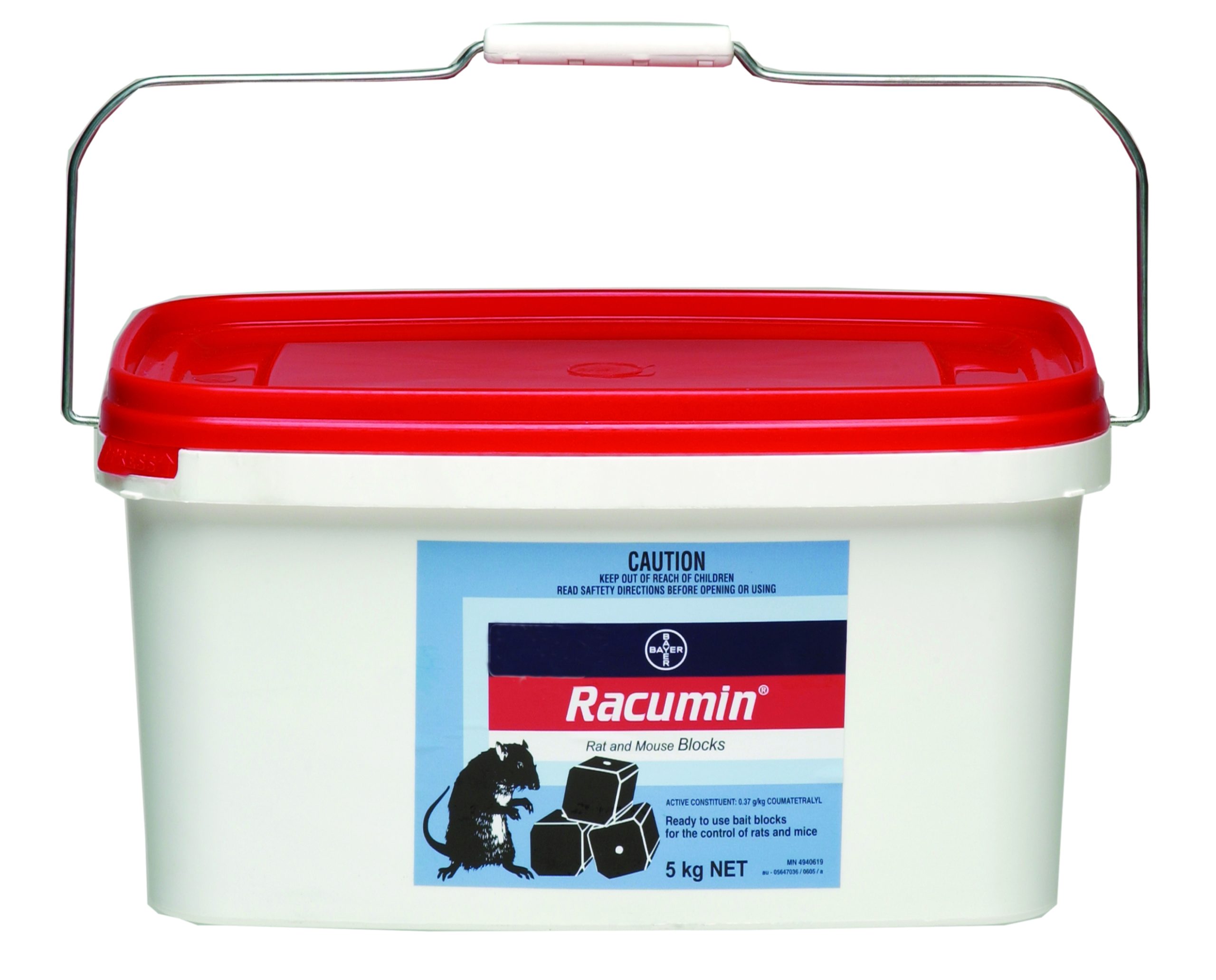
Product details
Formulation
Ready-to-use wax bait block (rodenticide). Coumatetralyl is a first-generation anticoagulant that works as a multi-feed bait.
Overview
Racumin Rat and Mouse Blocks are ready-to-use anticoagulant bait blocks for controlling rats and mice. They are APVMA registered (product no. 52098) and suit Pest Management Professionals working in domestic and industrial buildings, the outdoor areas around them, farm buildings, dairies, wharves and the non-product areas of meatworks.
Coumatetralyl is a first-generation, multi-feed anticoagulant. Rodents need to feed on it several times over a few days before control is achieved. Because of this, the risk of bait shyness is low and the risk of secondary poisoning to pets and wildlife that eat poisoned rodents is reduced.
The blocks are also registered for rat control in sugar cane, macadamias and pineapples. In these crops, bait must be placed in bait stations as part of a wider rodent control program.
Product Highlights
- Multi-feed, first-generation anticoagulant: the risk of bait shyness is low and the risk of secondary poisoning to non-target animals is reduced. This makes it a practical choice for sites near pets, livestock or wildlife.
- Weather-resistant wax block: holds up in damp and outdoor locations where loose grain or pellet baits break down.
- Covers both structural and crop work: one product is registered for buildings and the areas around them, plus in-crop rat control in sugar cane, macadamias and pineapples.
Target pests
- Rats
- Mice
- In field crops (sugar cane, macadamias, pineapples), the label covers rats only
Where to use
- Domestic and industrial buildings, and the external areas associated with them
- Wharf areas
- Around farm buildings
- Dairies
- Meatworks (non-product areas only)
- Field crops (rats): sugar cane, macadamias, pineapples
Application
Place blocks in areas of known rodent activity. Put them under cover where only rats and mice can reach them, for example behind appliances and furniture or in ceiling voids. Use bait stations for any placement in the open. Follow the label for rates and spacing.
- Remove other food sources as far as practicable before baiting.
- Bait for at least 2 weeks. Inspect and replace eaten baits regularly until no more bait is taken.
- Field crops: put bait stations in place several days before baiting so rats get used to them. Offer free feed during the first week. Place stations around crop perimeters, near rat runs and close to harbourage.
- Bait stations must hold the bait off the ground, keep it out of water and stop birds reaching it. The label describes three bait station designs: a tyre covered with corrugated iron, a PVC pipe with a screw-top T-piece, and a dish under an upturned ice-cream container.
- In crops, baiting must be part of a full rodent control program. This includes weed and scrub clearance, slashed headlands and encouraging predators such as owls.
- Collect dead rodents regularly. At the end of the program, remove and destroy any untaken bait.
- Do not apply on or near exposed food, food utensils, food preparation or storage areas, packaging materials, or livestock feed or water.
Safety
Signal heading: CAUTION. Poisons Schedule 5 (S5). Poisonous if swallowed.
- PPE: wear elbow-length PVC gloves when preparing and using the product. Wash gloves after each day's use.
- Avoid contact with eyes and skin. Do not inhale dust.
- After use, and before eating, drinking or smoking, wash hands, arms and face thoroughly with soap and water.
- Do not place bait anywhere children, livestock or domestic pets can reach it.
- The product, and dead or affected rodents, are hazardous to pigs, cats, dogs, poultry and non-target wildlife.
- Do not contaminate ponds, waterways or drains.
- Antidote: vitamin K1 (phytomenadione). For poisoning, contact a doctor or the Poisons Information Centre on 13 11 26.
- Store in the original container, tightly closed, in a cool, dry, well-ventilated place out of direct sunlight. Do not burn empty containers or product.
FAQ
- Why does it take longer than some single-feed baits? Coumatetralyl is a multi-feed anticoagulant, so rodents must eat it several times over a few days. The trade-off is a low risk of bait shyness. Plan for at least 2 weeks of baiting with regular top-ups.
- Is it safe around pets and livestock? It has a reduced secondary poisoning risk compared with stronger anticoagulants, but it is not risk-free. The product, and poisoned rodents, are hazardous to pigs, cats, dogs, poultry and wildlife. Use covered or tamper-resistant placements and remove dead rodents regularly. Take care in and near piggeries, and do not let bait contaminate pig or poultry feed.
- Can I use it in food premises or outdoors in wet conditions? It must not be used on or near exposed food, food preparation or storage areas, or packaging. In meatworks it is registered for non-product areas only. The wax block is weather-resistant and suits damp outdoor sites. In crops, though, it must sit in stations that keep it off the ground and out of water. Controlling protected native rodents requires permission from wildlife authorities.
Pack Size
5 kg pack of ready-to-use wax blocks. Each block weighs about 30 g (around 165 blocks per pack) and measures about 3 cm × 3 cm × 3 cm.
- How to order: RAC/BL/5