
Temprid 75 is a residual insecticide concentrate from Envu for the management of ants, cockroaches, spiders, fleas and bed bugs, including pyrethroid-resistant strains, in domestic, commercial, industrial and public buildings and facilities as per the Directions for Use. It pairs two active ingredients, imidacloprid and beta-cyfluthrin, in a single water-based formulation.

What Temprid 75 is
Temprid 75 is a suspension-type concentrate that is diluted in water and applied as a residual surface treatment. The two actives work in different ways: imidacloprid, a neonicotinoid, over-stimulates insect nerve cells, which enhances the potency of beta-cyfluthrin, a synthetic pyrethroid. Envu describes this combination as HAS (Homogenised Active Synergy) technology, where both actives are milled together to a controlled particle size so they act together for maximum effect.

Key features and benefits
- Two modes of action via two actives, reducing reliance on pyrethroids alone.
- Fast knockdown combined with long residual action. Envu reports at least twice the knockdown speed and at least ten times the residual efficacy of competitor products (Envu data on file).
- Flexibility: registered for use indoors and outdoors on a wide range of pests.
- Water based, with low odour and suitability for sensitive indoor environments when applied per label.
- Low application rate: 10 mL per 1 L of water.
- Cost effective per litre of finished spray.
- Backed by the Envu Performance Guarantee.
Where to use it in Australia
Temprid 75 suits the pests that generate most general-pest callouts in Australian homes and businesses:
- Ants trailing along skirtings, paths and external walls, including nuisance species around kitchens and entertaining areas.
- Cockroaches, including German cockroaches in food-handling areas and larger species harbouring outdoors.
- Spiders on eaves, fences, outdoor furniture and under floors.
- Fleas in carpets, pet bedding areas and subfloors.
- Bed bugs in accommodation, aged care and residential settings, where pyrethroid resistance is now common and a second mode of action is valuable.
How it fits into an IPM program
A residual insecticide is most effective when it is one part of an integrated approach. Inspect first to identify the species and harbourages, correct sanitation and exclusion issues, and then apply Temprid 75 to the cracks, crevices, surfaces and perimeters listed on the label. For bed bugs, combine treatment with heat, vacuuming and mattress encasements as appropriate, and follow up to confirm control. Rotating between chemical groups across accounts helps preserve the effectiveness of both actives.
Safety and compliance
- Temprid 75 is registered with the APVMA and must be used only as directed on the label, including pests, sites, rates and re-entry advice.
- Read the Safety Data Sheet and wear the personal protective equipment specified before mixing and applying.
- Application is restricted to appropriately licensed pest management technicians under state and territory legislation.
- Keep treated areas clear of children and pets until dry, and avoid contamination of drains, waterways and food-preparation surfaces.
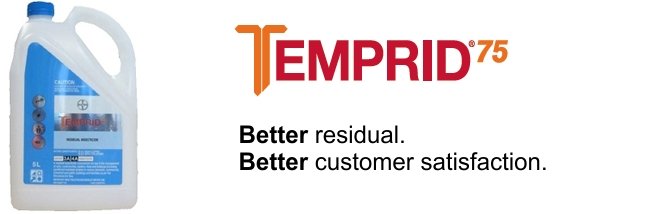
Available from Garrards
Garrards stocks Temprid 75 alongside the application equipment, PPE and complementary products you need for ant, cockroach, spider, flea and bed bug work. Ask your branch for the current label, SDS and pack options.
Contact your local Garrards branch
Frequently asked questions
What are the active ingredients in Temprid 75?
Temprid 75 contains imidacloprid and beta-cyfluthrin, combined through Envu’s HAS (Homogenised Active Synergy) milling technology.
What is the mixing rate for Temprid 75?
The stated application rate is 10 mL of Temprid 75 per 1 L of water. Always confirm the rate for the target pest and situation on the current APVMA-approved label.
Can Temprid 75 be used for pyrethroid-resistant bed bugs?
Yes. Temprid 75 is registered for bed bugs including pyrethroid-resistant strains, because the imidacloprid component adds a second mode of action.