
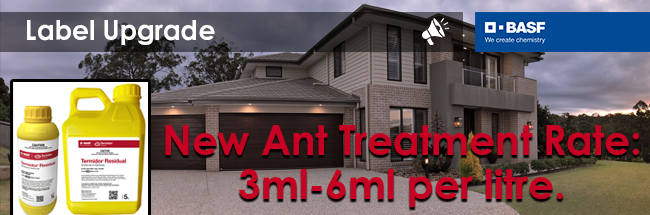
BASF has updated the Australian label for Termidor Residual Termiticide & Insecticide, and the headline change for pest managers is a lower ant treatment rate. Under the new Termidor Residual label, ant treatments can be applied at 3 mL to 6 mL per litre of water. The updated label is available to download below, and Garrards branches can supply both the product and a printed copy of the new directions.
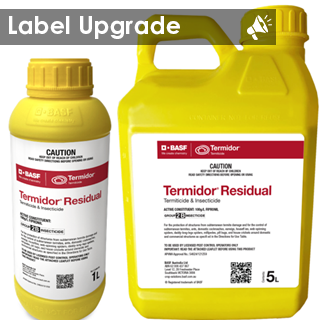
What has changed on the Termidor Residual label
- New ant treatment rate: 3 mL to 6 mL per litre. The lower end of this range is the significant change, giving pest managers a more economical option for external ant work.
- Flexible quarterly application: the updated label allows a quarterly external ant program, so a pest company can maintain continuous, year-round protection against ant infestations around a property rather than treating reactively.
- Stock on hand with the previous label: BASF advises that product already in your store or vehicle does not need to be returned or replaced. Download a copy of the new label, read it in full and keep it with the product.
The product itself is unchanged; only the approved directions for ant treatments have been expanded.
What the new rate means for your business
BASF has summarised the commercial case for the updated label as follows:
- Lower product use: at the lower application rate, BASF states you can use up to 50% less product per ant treatment, which translates to up to 50% saving on chemical cost for you and your clients.
- Proven performance on ants: Termidor has a long track record in Australian pest management, particularly against ants, where its non-repellent, transfer-effect action allows foraging workers to carry the active back into the nest and reach ants that never contact the treated surface.
- A year-round service offering: the quarterly external ant program gives you a basis for a top-tier annual service package for homeowners who want continuous protection rather than one-off call-outs.
- Fewer call-backs: BASF’s position is that Termidor Residual applications lead to higher customer satisfaction and fewer costly return visits compared with cheaper repellent treatments.
Termidor Residual compared with bifenthrin for ant work
Bifenthrin-based sprays are often the cheaper option per litre, and they remain a useful tool in many situations. For ant management, however, BASF points to some important differences:
- Bifenthrin is a repellent pyrethroid. Ants detect and avoid treated surfaces, so colonies are often pushed to new entry points rather than eliminated.
- Bifenthrin has no transfer effect. Only ants that directly contact the treated surface are affected, whereas Termidor is carried back through the colony by foraging workers.
- Bifenthrin generally requires higher application rates for ants and may not deliver the same long-term control, which is where return visits and customer dissatisfaction start to erode the initial price advantage.
Action required: using stock with the previous label
- Download the updated label from the link below and read it in full. Do not rely on a summary; the label is the legal document that sets out rates, situations, restrictions and safety directions.
- Keep a copy with the product. Print the new label and keep it with the container and the Safety Data Sheet in each vehicle and at your store.
- Update your procedures. Revise your standard operating procedures, treatment records and quoting templates so technicians are applying and recording the correct rate for ant work.
- Brief your technicians. Make sure everyone applying Termidor Residual knows the new rate range, when to use the lower and upper ends, and that the termite directions have not changed.
- Review your service agreements. If you intend to offer a quarterly external ant program, update your customer agreements and scheduling accordingly.
Why a non-repellent matters for Australian ant control
Australia’s most troublesome pest ants around homes and commercial premises, including coastal brown ants, black house ants, Argentine ants and white-footed house ants, form large colonies, often with multiple queens and multiple interconnected nests. Colonies of this type readily bud and relocate when they encounter a repellent barrier, which is why a spray that simply drives ants away can appear to work for a few weeks and then fail.
A non-repellent treatment applied along trails, nest entrances and external harbourage allows workers to continue foraging through the treated zone and pass the active ingredient to nest mates through grooming and food sharing. The quarterly program on the updated Termidor Residual label is designed around this behaviour: regular external applications keep the treated zone active through the warmer months when ant pressure peaks, and through winter in the warmer parts of the country where ants remain active year-round.
Safety and compliance
- Termidor Residual Termiticide & Insecticide is an APVMA-registered product and must only be used in accordance with the current approved label.
- Use is restricted to licensed pest management technicians. Licensing requirements are set by each state and territory health department or regulator.
- Wear the personal protective equipment specified on the label and refer to the Safety Data Sheet before use.
- Do not apply where run-off into drains, waterways or stormwater is likely, and observe all label restrictions around water and non-target areas.
- Record every application in accordance with your state’s pesticide record-keeping requirements.
Frequently asked questions
What is the new ant treatment rate for Termidor Residual?
The updated label allows ant treatments at 3 mL to 6 mL of Termidor Residual per litre of water. Read the label for the situations in which each rate applies.
Can I still use product that has the old label on the container?
BASF advises that product already in stock can continue to be used. Download the updated label, read it and keep a copy with the product. If you have any doubt about a specific batch, contact your Garrards branch.
Has the termite treatment rate changed?
No. The change relates to ant treatments. Directions for termite work are unchanged; always follow the current label.
How does the quarterly ant program work?
The updated label allows external ant treatments to be repeated on a quarterly basis, so you can offer customers a scheduled year-round ant management program rather than reactive one-off treatments.
Downloads
Available from Garrards
Termidor Residual Termiticide & Insecticide is available from every Garrards branch across Australia, along with printed copies of the updated label and the current Safety Data Sheet. Our branch staff can talk you through the new ant rate and how to build it into a quarterly service program.
Contact your local Garrards branch
Frequently asked questions
What is the new ant treatment rate for Termidor Residual?
The updated label allows ant treatments at 3 mL to 6 mL of Termidor Residual per litre of water. Read the label for the situations in which each rate applies.
Can I still use product that has the old label on the container?
BASF advises that product already in stock can continue to be used. Download the updated label, read it and keep a copy with the product. If in doubt about a specific batch, contact your Garrards branch.
Has the termite treatment rate changed?
No. The change relates to ant treatments. Directions for termite work are unchanged; always follow the current label.
How does the quarterly ant program work?
The updated label allows external ant treatments to be repeated quarterly, so you can offer customers a scheduled year-round ant management program rather than reactive one-off treatments.