
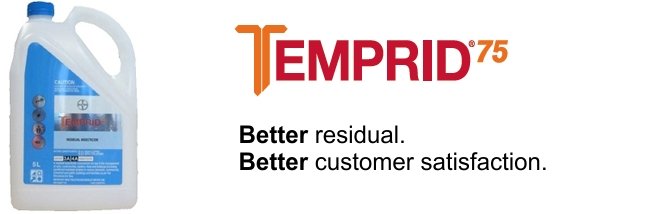
Temprid 75 from Envu is a dual-active residual insecticide concentrate that pairs imidacloprid with cyfluthrin to deliver fast knockdown and long residual control of ants, cockroaches, spiders, fleas and bed bugs. It is registered for use inside and outside domestic, commercial, industrial and public buildings, which makes it a general-purpose tool for reducing the call-backs that erode a pest control business’s reputation.

What a call-back really costs
Most pest control companies experience call-back rates of between 2 and 10 per cent on ant, cockroach and spider jobs. The direct cost of a return visit is only part of the picture:
- Around $50: the average cost of a call-back visit.
- Around $200: the value of a referral you may not receive from a dissatisfied client.
- Around $20,000: the cost of losing 10 per cent of customers in a year because they do not renew.
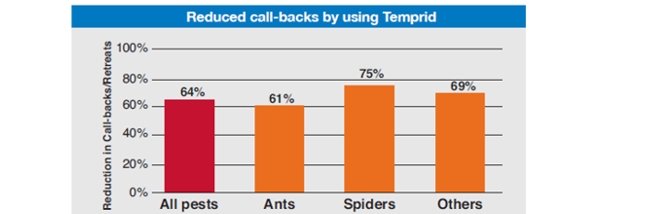
Envu reports that Temprid reduces call-backs by more than 60 per cent compared with conventional treatments.
Product details
| Product | Temprid 75 Residual Insecticide |
|---|---|
| Active constituents | 50 g/L imidacloprid; 25 g/L cyfluthrin |
| Formulation | Residual insecticide concentrate |
| Target pests | Ants, cockroaches, spiders, fleas and bed bugs (including pyrethroid-resistant strains) |
| Situations | Domestic, commercial, industrial and public buildings and facilities, indoors and outdoors, as per the Directions for Use |
Why two actives
Cyfluthrin is a synthetic pyrethroid that provides rapid knockdown and repellency. Imidacloprid is a neonicotinoid that is non-repellent and slower acting, so insects that contact a treated surface continue moving and transfer the active within harbourages and nests. Combining them gives immediate results the client can see, plus a residual that keeps working between visits. Because the two actives have different modes of action, the mix also controls pyrethroid-resistant strains, which is particularly relevant for bed bug work in Australia where pyrethroid resistance is well documented.
Where it fits in Australian pest work
- General pest treatments: perimeter and internal spraying for cockroaches, ants and spiders in homes and commercial premises.
- Bed bug programs: as a residual for cracks, crevices and bed frames, combined with inspection, heat or steam and client preparation.
- Flea treatments: indoor residual applications to carpets and pet resting areas alongside client vacuuming and pet treatment.
Used within an IPM approach, inspection, sanitation, exclusion and monitoring reduce reliance on the chemical and extend the interval between visits.
Safety and compliance
- Temprid 75 is an APVMA-registered product. Read the label and Safety Data Sheet and apply only as directed for the listed pests and situations.
- Wear the PPE specified on the label when mixing and applying.
- A state or territory pest management licence is required to apply this product commercially.
- Keep residual sprays away from food, food preparation surfaces, drains and waterways.
Downloads
The Safety Data Sheet, label and product brochure for Temprid 75 are available on request from your Garrards branch.
Available from Garrards
Temprid 75 is stocked by Garrards branches across Australia. Talk to your branch about pack sizes and current pricing.
Contact your local Garrards branch
Frequently asked questions
What are the actives in Temprid 75?
Temprid 75 contains 50 g/L imidacloprid and 25 g/L cyfluthrin in a residual insecticide concentrate.
Does Temprid 75 work on pyrethroid-resistant bed bugs?
The label covers bed bugs including pyrethroid-resistant strains, because imidacloprid provides a second mode of action alongside the pyrethroid cyfluthrin.
Can Temprid 75 be used indoors?
Yes. It is registered for use inside and outside domestic, commercial, industrial and public buildings, as per the Directions for Use.