
Starycide insect growth regulator is registered in Australia for the control of immature fleas, cockroaches and silverfish, indoors and outdoors. Its active constituent, triflumuron (48 g/L), is a chitin synthesis inhibitor with an unusually long residual life, which is why it is designed primarily as a tank-mix partner for residual sprays rather than a stand-alone treatment. This article, based on technical material by Jeffrey Einam, Technical and Regulatory Affairs Manager at Envu, explains how it works and where it earns its place in a program.
What makes Starycide different from other IGRs
Two things separate Starycide from most insect growth regulators registered for Australian pest control: its mode of action and its residual control. To understand both, it helps to remember how insects grow. An insect must shed its cuticle (moult) at intervals in order to increase in size, and the cycle of moulting, growth and eventual sexual maturity is controlled by hormones.
Group 1: juvenile hormone analogues (JHAs)
The first group of IGRs registered in Australia are the juvenile hormone analogues, which include methoprene, hydroprene, fenoxycarb and pyriproxyfen. As the name implies, a JHA mimics the hormone that keeps an insect in its juvenile form while it develops. The insect is tricked:
- It moults into an oversized larva and dies, or develops into a sterile adult that may show symptoms such as curly wings.
- Either way, no fertile eggs are laid and no new generation develops.
- Insects are generally only affected when exposed to the JHA just before the final moult. Adults and smaller larvae are unaffected, so there is no noticeable effect at other times.
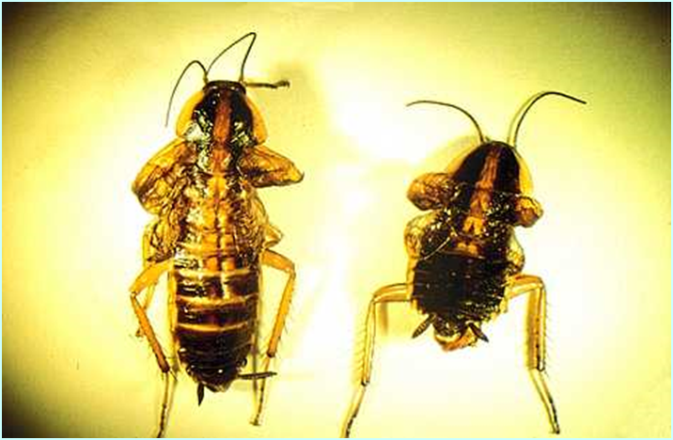
Take-home point: because JHAs only prevent the development of fertile adults, species whose larval or juvenile stages are themselves the pest (cockroaches, for example) will not be measurably affected by a JHA without an adulticide. Where only the adult is the pest stage (mosquitoes, for example), an adulticide plus a JHA can be very effective.
Group 2: chitin synthesis inhibitors (CSIs)
The second group are the chitin synthesis inhibitors, so called because they interfere with production of chitin, the most important component of the insect cuticle. This group includes triflumuron (Starycide), lufenuron, diflubenzuron and flufenoxuron.
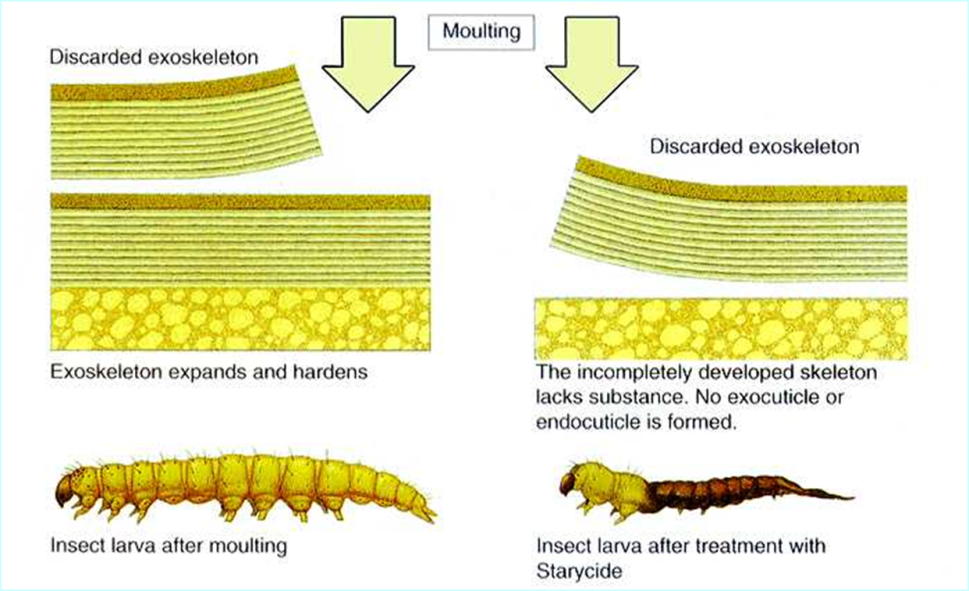
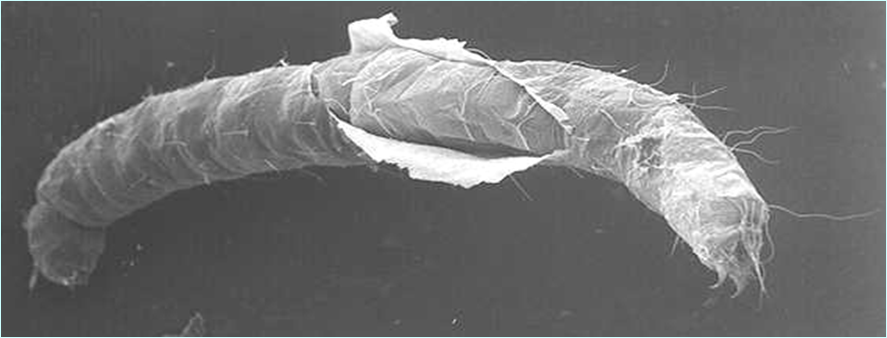
In a normal moult the old cuticle is shed, the insect inflates its body by taking in air, and the new cuticle hardens at the larger size. Where a CSI has prevented a new cuticle from forming properly, the old one is shed and the insect is left without a protective, supportive cuticle and soon dies. In practice it is rarely the whole cuticle that fails: weak points form, so the insect lacks the strength or leverage to escape its old skin, and if it does escape, the thin points lead to dehydration or death from other external influences.
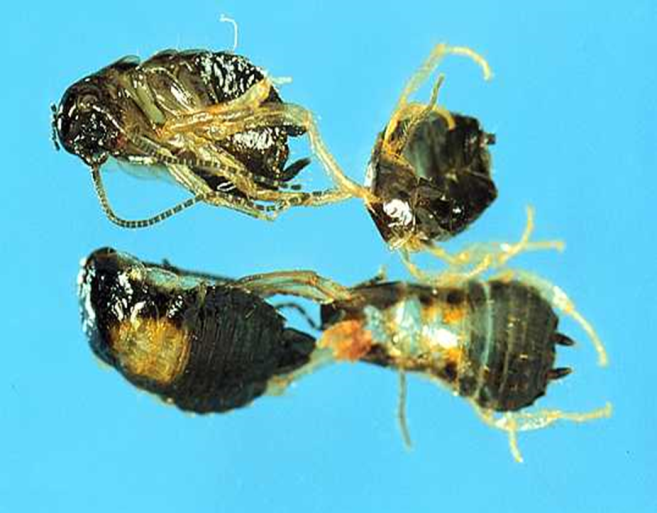
The practical difference for a pest manager is that Starycide affects insects at every larval moult, not just the last one.
Why the residual is so long
Triflumuron is extremely insoluble; it will not dissolve in water or in many other solvents. Being insoluble also means it is extremely unreactive, which makes it very resilient to UV breakdown and to alkaline surfaces such as concrete. According to Envu, it lasts on surfaces far longer than any other compound registered for pest control. Because triflumuron targets a metabolic process that mammals and birds do not have, it is also considered to have a very high margin of safety.
Fleas: field results in Australia
Flea insecticides have traditionally targeted the adult flea, because that is what the customer sees. Those compounds are often much less effective against larvae and frequently last only a month or two under practical conditions.
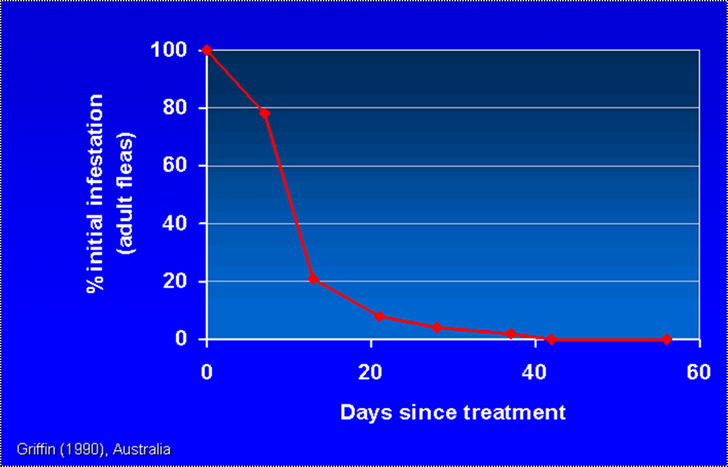
In an Australian field trial, indoor and outdoor flea problems were sprayed with triflumuron alone and adult numbers were monitored. It took three to four weeks for the population to disappear, roughly the life expectancy of an adult flea, and no re-spray was needed that season because the residual life can be about a year. Customers will not normally accept a three-to-four-week wait, which is why the combination of an adulticide (such as Temprid75 or Cislin25) and Starycide is the most robust option. Dogs and cats will occasionally bring home new fleas from untreated areas, but those fleas cannot establish a new population on treated ground. Pets should still be treated regularly with suitable flea products.
Cockroaches
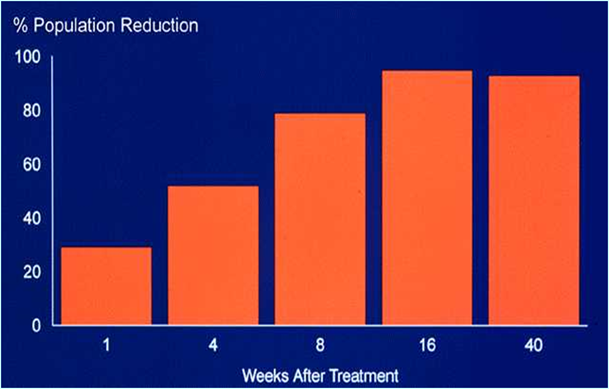
Used alone, Starycide took four months to reduce cockroach populations to low levels (95%+ control), and that level persisted for 40 weeks, so the residual is very good. No client will wait four months, though. A tank mix of Starycide with an adulticide gives a highly effective, long-term treatment.
Formulation and surface residues
Because triflumuron is so insoluble, Envu’s formulation chemists diluted the technical active by a factor of ten by micronising clay particles and using them to suspend triflumuron in water. Before this, use rates of 0.5-2 mL per litre were awkward to measure and easy to overdose or spill; the more dilute formulation allowed a convenient measure pack.
Two practical consequences:
- Visible residues. Starycide 48SC may leave a visible residue on some surfaces; it is the micronised clay you are seeing. Apply to a small test area first. Dark colours and non-porous surfaces are most likely to show it; carpet and outdoor flea applications and crack-and-crevice cockroach applications rarely do. Residues wipe off with a damp cloth.
- Equipment. Use appropriate application equipment as described in the Starycide technical bulletin (see Downloads).
Starycide is compatible with most residual sprays on the market, including the Envu range. If in doubt, confirm compatibility with your Envu representative before mixing.
When should you use Starycide?
- Routine domestic cockroach and silverfish services: probably not warranted. Where significant populations are present, the small extra cost of adding Starycide is a wise choice.
- All flea infestations: highly recommended with an adulticide such as Temprid75 or Cislin25. The adults that triggered the call-out can be as little as 5% of the total flea population at any one time; treating adults only is a guarantee of call-backs.
- Commercial cockroach accounts: make Starycide the foundation of the program. Its action on juvenile stages (a pest stage just like the adults) bolsters your residual spray and gel program, and a product resilient to breakdown is a big advantage in harsh, unpredictable commercial environments.
Product summary
| Product | Starycide Insect Growth Regulator (Starycide 48SC) |
|---|---|
| Active constituent | 48 g/L triflumuron |
| Registered use | Control of silverfish, immature fleas and cockroaches in indoor and outdoor situations |
| Mode of action | Chitin synthesis inhibitor (IGR) |
| Typical use | Tank-mix partner with a residual adulticide |
Safety and compliance
Starycide is an APVMA-registered product and must be used only as directed on the label. Read the current label and safety data sheet before use, wear the personal protective equipment the label specifies, and keep records of application in line with your state or territory licensing requirements. Advise customers on re-entry and on treating pets as part of any flea program.
Downloads
- Starycide safety data sheet (PDF)
- Starycide label (PDF)
- Starycide manufacturer’s declaration (PDF)
- Starycide technical bulletin (PDF)
- Starycide brochure (PDF)
Available from Garrards
Starycide and compatible Envu residual adulticides, including Temprid75 and Cislin25, are available through Garrards branches across Australia, along with the application equipment recommended in the technical bulletin.
Contact your local Garrards branch
Frequently asked questions
Can Starycide be used on its own for fleas?
It can, but adult fleas take three to four weeks to die out because Starycide only affects the immature stages. For an acceptable result, tank mix it with a registered adulticide such as Temprid75 or Cislin25.
How long does Starycide last after application?
Triflumuron is highly insoluble and resistant to UV and alkaline surfaces. In the Australian flea field trial described here the residual life was about a year, and in cockroach trials 95%+ control persisted for 40 weeks.
Will Starycide stain surfaces?
Starycide 48SC can leave a visible residue of micronised clay on dark or non-porous surfaces. Test a small area first. Residues wipe off with a damp cloth, and carpet, outdoor and crack-and-crevice applications rarely show them.
Is Starycide compatible with other residual sprays?
It is compatible with most residual sprays on the market, including the Envu range. If in doubt, confirm with your Envu representative.