
Sentricon AlwaysActive has been a mainstay of Australian termite baiting since 2015, and one of the most common questions Garrards hears from pest managers in flood-prone regions is how the termiticide rods hold up in water. This article summarises the history of the Sentricon System in Australia and the flooding and leaching studies conducted by Dow AgroSciences and Corteva Agriscience.

The Sentricon System in Australia
The Sentricon System has a history stretching back around 30 years. Dow AgroSciences Australia launched it here in 1997 as the first termite monitoring and baiting system available in Australia. Key milestones since then:
- 2004: Sentricon II Advanced Termite Control launched, with a changed business model and a far superior bait matrix.
- 2015: Sentricon AlwaysActive launched, a step change in termite management. Dow AgroSciences became Corteva Agriscience in 2019.
As the name suggests, AlwaysActive stations contain bait from the moment they are installed, so the system works as both a preventative and a curative treatment. It is complemented by Sentricon Above Ground Termite Bait. Both products use the same active ingredient, hexaflumuron, at 5 g/kg. Sentricon AlwaysActive is CodeMark certified and can be installed pre- or post-construction.
Why flooding matters in Australia
Since AlwaysActive was introduced, Joanne George, Business Manager for Sentricon, has fielded the flooding question from pest managers across northern Australia, where seasonal tropical rainfall routinely saturates in-ground stations, and more recently from the NSW Mid North Coast after major flooding in March 2021. Two Dow/Corteva studies address the concern directly.
Study 1: simulated flooding of Recruit HD rods (2010)
This study was conducted in November 2010 when AlwaysActive was first launched overseas. Recruit HD is the AlwaysActive rod used in that market; the only difference from the Australian rod is the active ingredient (0.5% noviflumuron rather than hexaflumuron). The rod matrix is identical.
One Recruit HD rod was placed in a Sentricon station and covered with purified water in a jar for up to three months. The test was run in triplicate and the water was analysed by a sensitive analytical technique on the day of flooding and monthly for three months. The findings:
- If Sentricon AlwaysActive stations are flooded, there is virtually no potential for the active ingredient to leach outside the station.
- The concentration of active in the water around the rods was extremely low and below the acute toxicity level for even the most sensitive aquatic species.
- Any free active is locked into the soil matrix, even when flooded, and does not move into the surrounding environment.
- The concentration in water did not increase with the length of time the rod was flooded.
Study 2: hexaflumuron concentration after flooding termiticide rods (2015)
The second study used the hexaflumuron rods supplied in Australia. Rods were placed in glass graduated cylinders and covered with aqueous calcium chloride in the dark at ambient temperature. A single sample was taken on day 1 and triplicate samples on days 36 and 92. The rods were removed, the flood solution was decanted into glass jars, the cylinders were rinsed with methanol and the rinse added to the solution, and replicate aliquots were diluted and analysed for hexaflumuron. The conclusions:
- No significant difference between day 1 and day 92 results.
- Any hexaflumuron measured in the simulated stagnant floodwater was most likely rinsed from the exterior of the rod rather than leached from within it.
- The design represented a worst-case scenario: the flooding period was excessive, indicating extremely low environmental exposure from flooded hexaflumuron rods.
Real-world flooding and palatability
Field experience overseas after a major hurricane, where stations sat in stagnant water for several weeks, supports the laboratory results. Baits recovered from floodwater were sent to Dow/Corteva for palatability testing, and termites readily accepted them in the laboratory despite their weathered appearance. Stations were also reported to be attacked again by termites once the water subsided, demonstrating both palatability and durability in a worst-case event.
A 12-month immersion test
After being asked the flooding question during a visit to Darwin in 2017, Ms George ran her own experiment: a rod fully immersed in a jar of water for over a year. The photographs below show the rod on day one, at three months and at six months.
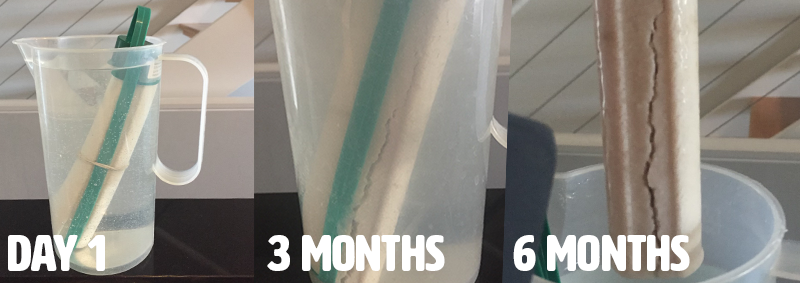
A crack appeared after three months, which is normal and expected. The rod’s condition did not change further at six months or at twelve months; it remained as solid as on day one.
What this means for your termite management program
- Flooded stations do not need to be replaced simply because they went under water.
- Minimal leaching means very low environmental exposure, an important consideration near waterways and in wet-season conditions.
- Rod integrity and palatability are maintained, so termite activity at stations can resume as soon as conditions allow.
- Continue routine inspections in line with the Sentricon program and AS 3660 requirements after a flood event to confirm station condition and termite activity.
Safety and compliance
Sentricon AlwaysActive is an APVMA-registered termite management product and must be installed and serviced according to the label and the Sentricon program requirements by licensed pest managers. Termite management in Australia should be carried out in accordance with AS 3660 and the relevant state or territory licensing regime.
Available from Garrards
Garrards distributes the Sentricon System, including Sentricon AlwaysActive in-ground stations and Sentricon Above Ground Termite Bait, to accredited pest managers across Australia. Learn more about Sentricon AlwaysActive or speak to your branch about program requirements and training.
Contact your local Garrards branch
Frequently asked questions
Do I need to replace Sentricon AlwaysActive rods after a flood?
Corteva’s studies and field experience show rods maintain their integrity and palatability after prolonged immersion, so flooding alone is not a reason for replacement. Inspect stations after the event and follow the Sentricon program requirements.
Does hexaflumuron leach from flooded Sentricon stations?
Studies found virtually no potential for the active to leach outside the station, with concentrations in surrounding water extremely low and below acute toxicity levels for sensitive aquatic species.
Can Sentricon AlwaysActive be installed on new builds?
Yes. Sentricon AlwaysActive is CodeMark certified and can be installed pre- or post-construction.