
The Globally Harmonized System (GHS) of classification and labelling of chemicals became mandatory in Australia for hazardous chemicals manufactured or imported from 1 January 2017. Shortly before that date, Safe Work Australia varied the transition so that stock already in the supply chain did not need re-labelling. This article explains the change, how to check whether an SDS is GHS compliant, and what pest management companies need to do at customer sites.

What changed
On 25 November 2016 Safe Work Australia members agreed that chemicals manufactured or imported before 1 January 2017 could continue to be supplied without meeting the GHS labelling requirements of the model Work Health and Safety Regulations. Safe Work Australia CEO Michelle Baxter said the approach would “ensure a smooth transition to the GHS, and will avoid an unnecessary burden on suppliers to re-label existing chemical stock”. The media release of 5 December 2016 is available on the Safe Work Australia website.
In practice, GHS compliance applies to hazardous chemicals manufactured or imported on or after 1 January 2017. Labels on product already in the supply chain remain acceptable. The ruling applies to all hazardous products, not just agvet pesticides.
Safety data sheets
Manufacturers had until 1 January 2017 to provide GHS-compliant SDS. Garrards worked with suppliers to obtain updated SDS and most SDS available on garrards.com.au were updated to GHS format during 2016.
How to tell if an SDS is GHS compliant
- Any SDS updated in 2016 or later should be GHS compliant.
- Section 2 is titled “Hazard Identification” and may refer to the GHS.
- Hazardous products carry H (hazard) and P (precautionary) statements instead of the older R (risk) and S (safety) statements.
- Pictograms are part of the GHS but are not mandatory on an SDS.
- If the product is non-hazardous, the SDS does not need to change.
Distributing SDS to your customers
Pest management companies servicing food premises, hospitals, schools, mines and similar sites generally need to replace the SDS held on site with GHS-compliant versions. Garrards encourages companies to distribute SDS to customers electronically. Garrards checked with food-premises auditors, who confirmed that SDS held electronically are accepted.
Changes to product labels
Labels on hazardous goods changed gradually through 2017 as product manufactured or imported after 1 January 2017 flowed from manufacturers through Garrards to customers. Some products gained a GHS text box; others did not change at all. Label requirements are complex: APVMA-registered pesticides have exemptions where the approved label already carries similar wording, or where the label is too small to fit GHS wording or pictograms.
Background to the GHS
The global classification system for hazardous chemicals was initiated at the United Nations conference in Rio in 1992, with the first edition published in 2000. Australia adopted the third edition (2009). The aim is a single worldwide method for chemical classification, labelling and SDS, so that users receive practical, reliable and easy-to-understand hazard information and can take appropriate protective measures. It was also promoted as delivering trade benefits through internationally consistent criteria.
Once a product’s hazard is classified, the statements on the SDS are fixed and mandatory. All formulation components are assessed, not just the active ingredient, so an emulsifiable concentrate may now appear more hazardous once its solvent system is taken into account.
Why there was confusion
Safe Work Australia adopted the GHS into the model WHS Regulations in 2012 for implementation on 1 January 2017. Because pesticides are already regulated by the APVMA, manufacturers expected them to be exempt from the relatively minor SDS and label changes. The announcement of 25 November 2016, just five weeks before implementation, did not exempt agvet products but changed the manner of implementation from the whole supply chain to new manufacture and import only. The main sources of confusion were:
- Whether APVMA-registered products would be exempt.
- Whether distributors could physically comply by the same deadline as manufacturers and importers.
- Differences in self-determined hazard classification. Manufacturers and importers must classify a chemical before supply, and different companies have interpreted similar products differently, producing different SDS hazard levels.
You would expect products with the same amount of the same active in the same formulation type to have similar SDS. Garrards compared many SDS for apparently similar products and found marked differences in signal words and hazard categories.
Pictograms
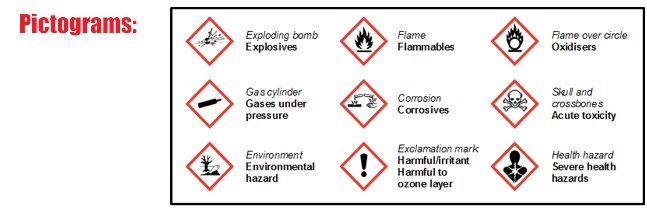
The hazard pictogram and signal word may be omitted from agvet chemical labels. The GHS has nine hazard pictograms covering physical, health and environmental hazards: explosives, flammables, oxidisers, gases under pressure, corrosives, acute toxicity, environmental hazard, harmful/irritant (including harmful to the ozone layer) and severe health hazards.
Two UN pictogram systems now operate side by side: GHS pictograms for hazardous products and packaging, and the UN Dangerous Goods class labels required for transport. The WHS Regulations allow manufacturers and importers to continue using dangerous goods class labels on containers of workplace hazardous chemicals. These are the diamond labels used to meet the Australian Code for the Transport of Dangerous Goods by Road and Rail (ADG Code).
Signal words
The GHS uses “Danger” for more severe hazards and “Warning” for less severe hazards. This means two signal-word systems now operate: GHS “Danger” and “Warning” on the SDS of hazardous agvet products, and the APVMA poisons scheduling wording of “Dangerous Poison”, “Poison” and “Caution” on product labels.
Action required
- Download current SDS for every product you use from garrards.com.au and replace outdated SDS in your vehicles and office.
- Replace SDS held at customer sites, preferably by moving to electronic distribution.
- Brief technicians on the new H and P statements and signal words so they can read a GHS-format SDS.
- Expect a mix of old and new labels on shelf stock; both are acceptable.
Further information
- Safe Work Australia: hazardous chemicals
- Safe Work Australia: GHS frequently asked questions
- Code of Practice: Labelling of Workplace Hazardous Chemicals
- Code of Practice: Preparation of Safety Data Sheets for Hazardous Chemicals
Downloads
Available from Garrards
Current SDS for the products Garrards distributes are available on our website, and our branch staff can help you locate the right document for any product.
Contact your local Garrards branch
Frequently asked questions
Do I need to replace old-format SDS at customer sites?
Yes, sites such as food premises, hospitals, schools and mines will generally expect GHS-compliant SDS. Electronic SDS are accepted by food-premises auditors, so this is a good time to move to electronic distribution.
Is product with a pre-2017 label still legal to use?
Yes. Hazardous chemicals manufactured or imported before 1 January 2017 can continue to be supplied and used with their existing labels.
Why does the SDS say 'Danger' when the label says 'Poison'?
Two systems operate at once: GHS signal words (‘Danger’ and ‘Warning’) on the SDS, and APVMA poisons schedule wording (‘Dangerous Poison’, ‘Poison’, ‘Caution’) on the registered label.