
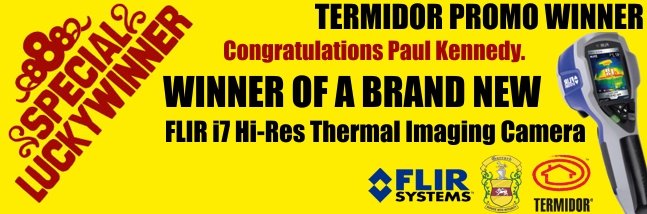
In June 2013 Garrards ran a Termidor promotion with a FLIR i7 thermal imaging camera, valued at $2,999 at the time, as the major prize. The draw was made in July 2013 and Paul Kennedy of Wise Pest Control in New South Wales was announced as the winner. Paul was already a keen fan of the FLIR i7, so the camera went straight to work on termite inspections.
The promotion and the winner
Garrards regularly runs supplier-backed promotions for professional pest managers, and the 2013 Termidor promotion was one of the more popular ones. Entrants went into the draw for a FLIR i7, the top model in the FLIR i-Series of entry-level thermal imaging cameras.
Why thermal imaging matters in Australian termite work
A thermal imaging camera does not see termites. It measures surface temperature and displays differences as an image. Active termite workings, moisture from leaks, and voids behind linings can all produce temperature patterns that differ from surrounding material, which gives an inspector a reason to look more closely with a moisture meter, sounding tools or a borescope.
Used this way, thermal imaging is a non-invasive aid that complements, rather than replaces, the visual inspection required under the Australian Standards for timber pest inspections and termite management of existing buildings. Any thermal anomaly still needs to be confirmed before it is reported as termite activity, and the absence of an anomaly is never proof that a wall is clear.
- Scan internal walls, skirting lines, wet areas and areas adjoining concealed timber quickly and without damage.
- Identify moisture problems (a major termite attractant) that would otherwise be missed.
- Document findings with radiometric images that can be attached to inspection reports.
- Demonstrate a thorough inspection method to clients, insurers and auditors.
About the FLIR i-Series (i3, i5 and i7)
At the time of the promotion the FLIR i-Series was marketed as the smallest, lightest and most affordable thermal imaging camera range on the market. It was designed for entry-level users: point, shoot and detect, with no prior thermography experience required. Key features as described by FLIR were:
- Ease of use: intuitive controls designed for first-time users, supplied with a full manual.
- Fully automatic: instant point-and-shoot JPEG thermal images carrying all temperature data.
- Focus free: a fixed focus-free lens.
- Compact and lightweight: 365 g, small enough for a belt pouch.
- Rugged: withstands a 2 metre drop, splash proof and IP43 rated.
- SD card storage: radiometric JPEGs with a unique ID stored on a standard miniSD card, with USB transfer to PC.
- Software included: FLIR Tools reporting and analysis software, with compatibility with FLIR Reporter.
- Measurement accuracy: ±2°C or ±2%, measuring up to +250°C and detecting differences as small as 0.10°C.
- Measurement functions: spotmeter, box with maximum and minimum temperatures, and isotherm above/below (depending on model).
Model comparison
| Specification | FLIR i3 | FLIR i5 | FLIR i7 |
|---|---|---|---|
| Thermal image resolution | 60 x 60 pixels | 100 x 100 pixels | 140 x 140 pixels |
| Field of view | 12.5° x 12.5° | 21° x 21° | 29° x 29° |
| Measurement modes | Centre spot | Centre spot | Spotmeter, area max/min, isotherm above/below |
| Thermal sensitivity | 0.15°C | 0.10°C | 0.10°C |
Higher resolution and a wider field of view are the main reasons the i7 was the preferred model for building inspection: more pixels give a clearer picture of small temperature differences across a wall, and the wider view covers more area per image.
Choosing a thermal camera for pest inspections today
Camera models change regularly, but the things that mattered in 2013 still apply. When comparing thermal imaging cameras for termite inspection work, look at thermal resolution, thermal sensitivity, field of view, whether images are radiometric (so temperature data is retained for reporting), battery life, ruggedness and the reporting software supplied. Training in how to interpret thermal images is just as important as the hardware.
Available from Garrards
Garrards supplies inspection equipment, including thermal imaging cameras, moisture meters and termite detection tools, along with Termidor and other termiticides, through branches across Australia. Camera models are updated over time, so check with your branch for the thermal imaging cameras and current promotions available now.
Contact your local Garrards branch
Frequently asked questions
Can a thermal imaging camera detect termites?
Not directly. A thermal camera shows surface temperature differences that may be caused by termite activity, moisture or voids. Any anomaly must be confirmed with other inspection methods before it is reported as termite activity.
Is thermal imaging required for a termite inspection in Australia?
No. The Australian Standards for timber pest inspections describe a visual inspection using non-invasive methods. Thermal imaging is an optional aid that can improve the thoroughness of the inspection and the quality of the report.
Does Garrards still stock the FLIR i7?
The FLIR i-Series was current in 2013. Contact your local Garrards branch for the thermal imaging cameras stocked today.