
Springtails (Collembola) are tiny jumping hexapods that Australian pest managers are increasingly asked about: “They are very small, they jump, they don’t sting, and I have never seen them before. What are they?” This guide explains what springtails are, why they turn up in homes, when they are a genuine pest and how to manage them.

The problem: springtail calls on the rise
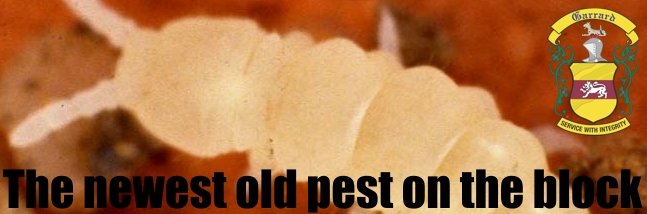
Calls about springtails have increased steadily. Two clients of pest managers were on the point of moving house because of the sheer numbers invading their homes: “I clean them up and they are back straight away.” A school principal was concerned about masses of small jumping creatures on a concrete path, concentrated in a circle about 150 mm across. That patch was a low-lying, last-to-dry hollow in the concrete, which is the key to understanding springtails: they are moisture sensitive and gather wherever damp persists.
Background: pre-insect hexapods
Springtails are not insects. The superclass Hexapoda (six-legged arthropods) contains four classes: Collembola, Protura, Diplura and Insecta. In the first three, the mouthparts are enclosed within the head capsule, which separates them from true insects, whose mouthparts are external. Protura are less than 2 mm long and uncommon, occasionally found when sampling moist soil. Diplura reach up to 50 mm but live under logs and stones and in moist soil. Collembola, the springtails, are the widespread group and the one pest managers encounter.
Identification: what springtails are
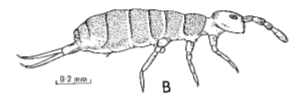
- Size: small, most under 6 mm.
- Distribution: over 2,000 species described worldwide, from subarctic regions through the tropics to Antarctica. In Australia they have been recorded from intertidal zones on coral reefs to Mount Wellington in Tasmania, where large dark patches on the snow turned out to be many thousands of springtails.
- Respiration: they breathe through their porous skin, which makes them prone to drying out and is why they are found in damp places.
- Age: fossil records date springtails to at least 400 million years ago.
- Abundance: one of the most abundant animals on earth, with up to 100,000 individuals per cubic metre of soil. Most live in leaf litter and decaying material, and they are also among the most abundant animal groups in trees, especially in the tropics. They are a major biological control agent of soil micro-organisms.
- The jump: most species have a tail-like furcula folded under the body and held under tension by a small clip on the abdomen. When released it snaps against the ground and flings the springtail into the air, all in about 18 milliseconds.
Why springtails are mostly beneficial
Most springtails clean up the micro-environment by feeding on decaying vegetable matter, algae, fungi and lichens, and decomposing animal matter such as dead earthworms and flies. They help spread some beneficial symbiotic fungi in agriculture and consume some disease-causing micro-organisms. In a garden or subfloor they are doing useful work, and they do not bite, sting, damage buildings or carry disease.
When springtails become a pest
- Agriculture: one group prefers fresh plant material. The lucerne flea causes severe damage to crops in the winter-rainfall areas of southern Australia.
- Skin irritation: there is evidence that scales or hairs from springtails can irritate when rubbed into the skin.
- Nuisance indoors: they can build up to very large populations in damp rooms such as bathrooms, laundries and basements, and around damp paths and paving outside. The nuisance is numbers, not damage.
Managing springtails: find the moisture
Products registered against the lucerne flea are agricultural products based on organophosphate or carbamate actives, and none are registered for use inside houses. Household aerosols will kill springtails they contact, but if they keep coming back the source has not been dealt with.
Springtails prefer moist conditions, and most indoor problems are reported after dry periods: as their normal habitat dries out they move in search of moisture, and they can climb smooth surfaces to find it. Many reports are one-off events that resolve once conditions change. Adults produce an aggregation pheromone, however, so where some survive, others will join them.
Step-by-step approach
- Confirm the identification: tiny, jumping, non-biting, concentrated in damp spots.
- Ask when the problem started and whether it followed a dry spell, plumbing work or a wet area leak.
- Inspect for the moisture source that is sustaining them. Outdoors this may be damp soil, mulch, low-lying paving, blocked drains or overwatered garden beds against the house. Indoors check under the bath and shower, around laundry plumbing, under sinks and in subfloors for leaks or condensation.
- Fix the moisture problem: repair leaks, improve drainage and ventilation, and move mulch and irrigation away from the walls. This is the only long-term solution.
- If the source is outside, apply a registered perimeter treatment to the exterior of the building, including up the walls, following the label.
- Advise the client on housekeeping in wet areas and follow up if numbers persist, which points to a moisture source that has not been found.
Safety and compliance
Only use products registered by the APVMA for the situation, and follow the label for the site and application method. Agricultural lucerne flea products are not registered for indoor domestic use. Wear the PPE specified on the label and comply with your state or territory pest management licence conditions.
Frequently asked questions
Are springtails harmful?
No. They do not bite, sting, damage buildings or transmit disease. Their scales or hairs can occasionally irritate skin, but the main issue is nuisance numbers.
Why do springtails suddenly appear inside?
Usually because their outdoor habitat has dried out and they are moving in search of moisture. They will settle wherever damp persists, such as bathrooms and laundries.
Will spraying get rid of them?
Spraying kills the springtails present but they will return while the moisture source remains. Finding and fixing the damp is the real treatment.
Available from Garrards
Garrards stocks a range of APVMA-registered perimeter insecticides, inspection equipment and moisture meters to help you locate and treat springtail sources. Speak to your branch about the right product for the site.
Contact your local Garrards branch
Frequently asked questions
Are springtails harmful?
No. They do not bite, sting, damage buildings or transmit disease. Their scales or hairs can occasionally irritate skin, but the main issue is nuisance numbers.
Why do springtails suddenly appear inside?
Usually because their outdoor habitat has dried out and they are moving in search of moisture. They will settle wherever damp persists, such as bathrooms and laundries.
Will spraying get rid of them?
Spraying kills the springtails present but they will return while the moisture source remains. Finding and fixing the damp is the real treatment.