
The Makita 18V cordless blower and drill combo was put together by Garrards as a practical equipment kit for professional pest managers. The cordless blower is well suited to applying insecticidal dusts into roof voids, wall cavities and other enclosed spaces, while the drill covers the access holes, fixings and general site work that go with termite and general pest treatments.

What is in the kit
- 1 x Makita 18V cordless blower (BUB182Z)
- 1 x Makita 18V cordless drill (BDF452Z)
- 2 x 18V lithium-ion battery packs (BL1815)
- 1 x Makita charging station (DC18SD)
- 1 x Makita blow-mould carry case with parts storage
The lithium-ion batteries reach full charge in around 30 minutes. With two packs in the kit, one battery can be charging in the vehicle while the other is in use on site, which keeps a technician working through a full day of dusting jobs.
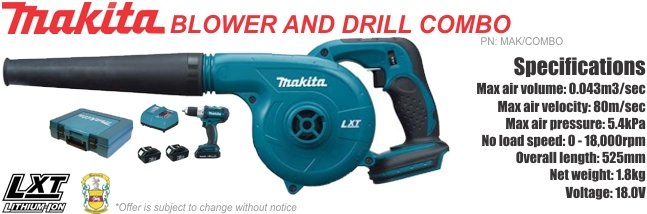
Cordless blower specifications
| Specification | Value |
|---|---|
| Maximum air volume | 0.043 m³/sec |
| Maximum air velocity | 80 m/sec |
| Maximum air pressure | 5.4 kPa |
| No-load speed | 0–18,000 rpm |
| Overall length | 525 mm |
| Net weight | 1.8 kg |
| Air volume settings | 3 |
| Operating time | Up to 75 minutes per charge |
The blower has variable speed control and an anti-static design, which matters when moving fine powders that would otherwise cling to the housing and tube.
Cordless drill features
- Compact, lightweight 4-pole motor
- All-metal gears and gear-change mechanism
- Mechanical 2-speed gearing with variable speed
- Electric brake
- Single-sleeve keyless chuck
- LED job light with afterglow
- Anti-slip rubberised grip
- 30-minute battery charge time
Why pest managers use a cordless blower for dusting
Dusting is a long-established technique in Australian pest management. Roof voids, wall cavities and subfloors are treated with insecticidal dusts for cockroaches, spiders, ants and other crawling pests because dusts persist well in dry, undisturbed spaces where liquid sprays are impractical. A cordless blower gives the technician a portable, controllable source of airflow to distribute dust throughout a void without dragging power leads through a ceiling. The three air-volume settings and variable trigger allow the operator to control how far and how hard the dust is pushed, and the low weight reduces fatigue when working at arm’s length in a hot roof space.
The drill earns its place in the same case: drilling injection or inspection holes, fitting bait stations and monitoring devices, and removing access panels are all routine parts of termite and general pest work.
Safety and compliance
- Only apply dust products that are registered with the APVMA, and always follow the label directions for rate, placement and situation.
- Wear the personal protective equipment specified on the product label. For dusting in confined spaces this typically includes a suitable respirator, eye protection and gloves.
- Roof voids in Australia can reach extreme temperatures in summer. Plan roof-space work for cooler parts of the day and take heat-stress precautions.
- It is widely recommended in Australia to switch off mains power at the switchboard before entering a roof space, and to keep dust and equipment clear of wiring and downlights.
- Applying pesticides commercially requires the appropriate state or territory pest management licence.
Available from Garrards
This combo was offered by Garrards as a limited kit and its contents and pricing may have changed since. Garrards continues to supply dusting applicators and application equipment for pest managers across Australia. Contact your local branch for current Makita kits and dusting equipment.
Contact your local Garrards branch
Frequently asked questions
Can a cordless blower be used to apply insecticidal dust?
Yes. Pest managers use cordless blowers to distribute registered insecticidal dusts through roof voids and wall cavities. Always apply dusts according to the APVMA-approved label and wear the PPE it specifies.
How long does the Makita battery take to charge?
The 18V lithium-ion batteries in this kit reach full charge in about 30 minutes, and the kit includes two batteries so one can charge while the other is in use.