
Envu’s professional range includes two products that fill different roles in a pest management program: Starycide, a triflumuron-based insect growth regulator, and Rodilon, a difethialone rodent bait. Both were released to the Australian professional market through Garrards, and both remain useful tools when applied in line with their APVMA-approved labels.

Starycide insect growth regulator
How it works
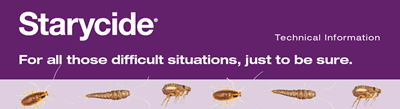
Starycide contains the active ingredient triflumuron, an insect growth regulator (IGR) that interferes with chitin synthesis. Chitin is the material insects use to build their exoskeleton, so an insect exposed to triflumuron cannot moult successfully. This mode of action is highly selective: it targets a process that mammals and other higher vertebrates do not have, which is why IGRs are regarded as having a favourable safety profile for operators, occupants and pets when used according to the label.
Key features
- Selective mode of action that acts on immature insects at the moult.
- Strong residual activity on treated surfaces.
- Produces a slow but steady decline in the target pest population rather than an instant kill.
- Complements synthetic pyrethroid treatments, which provide quick knockdown of adults and nymphs while the IGR stops the next generation.
Where it fits in an IPM program
Because an IGR does not kill adult insects quickly, Starycide is best used as the long-term component of a program: the pyrethroid deals with the visible infestation and the IGR breaks the breeding cycle so the population does not rebound. Always check the current Starycide label for the registered target pests, situations and application rates in Australia.
Rodilon professional rodenticide

How it works
Rodilon combines difethialone, a more recently developed second-generation anticoagulant, with a bait matrix formulated for high palatability. Anticoagulant rodenticides work by preventing blood clotting; rodents continue to feed normally for several days after taking a lethal dose, which avoids the bait shyness that can occur with fast-acting poisons.
Key features
- Effective against both rats and mice.
- Highly palatable matrix encourages uptake even where competing food is present.
- Suited to use as a first-line bait to gain rapid control of an active infestation.
Using Rodilon responsibly
In Australia rodenticide baits must be placed in accordance with the label, and in most professional situations that means inside a tamper-resistant bait station secured where children, pets and non-target wildlife cannot reach it. Record bait placements, inspect stations regularly, remove dead rodents where practical, and retrieve uneaten bait at the end of the program to minimise secondary poisoning risk to native owls and other predators.
Safety and compliance
- Both products are for professional use and must be applied strictly in accordance with their APVMA-approved labels.
- Wear the personal protective equipment specified on the label and Safety Data Sheet (SDS).
- Pest management technicians must hold the licence required in their state or territory.
- Current SDS and any export or quarantine treatment approvals should be obtained from the manufacturer or your Garrards branch.
Downloads
- Starycide 48 SC label (PDF)
- Starycide technical bulletin (PDF)
- Starycide brochure (PDF)
- Rodilon professional rodenticide label (PDF)
- Rodilon technical bulletin (PDF)
Available from Garrards
Starycide and Rodilon are available through Garrards branches nationally. For current pack sizes, pricing and technical advice on fitting either product into your treatment program, contact your local branch.
Contact your local Garrards branch
Frequently asked questions
Does Starycide kill adult insects?
No. Triflumuron is an insect growth regulator that stops immature insects moulting successfully, so the population declines over time. Pair it with a pyrethroid if you need immediate knockdown of adults.
Why use a palatable bait like Rodilon?
Rodents that have plenty of alternative food will ignore an unattractive bait. A highly palatable matrix improves uptake, and a single-feed anticoagulant means less bait needs to be consumed to deliver a lethal dose.