Product details
Formulation
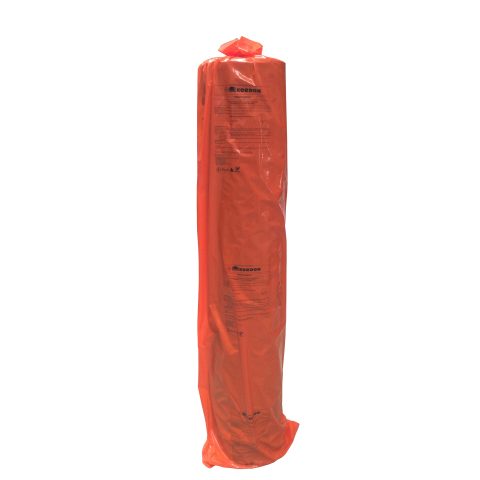
Kordon is a flexible, insecticide-impregnated laminate sheet. It meets the performance criteria of a chemical in a non-soil matrix, but it is installed using the principles of sheet material barriers.
- Construction: an orange low-density polyethylene (LDPE) top membrane, a fibrous polyolefin middle layer impregnated with deltamethrin, and a black lower membrane.
- Chemical family: synthetic pyrethroid.
- Poisons schedule: no poison schedule number allocated.
Overview
Kordon Termite Barrier is a laminate that goes into a building during construction to stop subterranean termites getting in unseen. It is APVMA approved (approval number 60759/52075) to protect buildings and structures against subterranean termites in line with AS 3660 Termite Management.
Termites can enter unseen through cracks in concrete and gaps around pipes that pass through the slab. Deltamethrin strongly repels termites, so where Kordon is installed they look for food elsewhere or try to go around the barrier. To get around it they build mud tubes, which a qualified inspector can spot during a routine inspection. This means the colony can be dealt with before major damage is done.
This listing is a pack of three 100 mm × 50 m rolls. The narrow width suits detailing work such as perimeter and penetration work. It is not meant for full under-slab coverage.
Product Highlights
- Physical barrier plus repellent: the laminate blocks hidden entry, and the deltamethrin repels termites and kills them on contact. Termites that try to go around it leave mud tubes that inspectors can see.
- Long-term performance: field trials show it keeps stopping hidden termite entry for at least 20 years. The membrane is UV stabilised, and deltamethrin in the sheet showed no significant breakdown after at least 3 months exposed on a concrete slab. This matters for perimeter work, which often stays exposed until the build is finished.
- Building compliance: holds a 2024 CodeMark Certificate of Conformity (CM40380) as a termite management system and as a damp-proof course and flashing material. Testing showed no respirable dust or volatile organic compounds (VOCs), so it meets the requirements for low-allergen housing construction.
Target pests
- Subterranean termites
Where to use
The directions for use apply in all states except Tasmania.
- New building work, extensions, renovations and retaining walls
- Other construction situations that need termite protection or management
- Perimeter barriers (all construction types), including in-fill slabs and slab-edge rebates. A perimeter barrier only partly protects a building and must be combined with other approved termite barrier systems under AS 3660.1.
- Service penetrations, as a manual alternative where the prefabricated Kordon collar can't be used
Application
Installers must have completed Kordon Accreditation and Training, and must be assessed competent in Unit 42A, Install Physical Termite Barriers. Pest Management Professionals should know the current editions of AS 3660.1 and the Building Code of Australia (BCA). The Kordon Installation Manual has full installation details.
- Before installing: inspect the site, eliminate any active nest of an economically important subterranean termite species within the property boundary up to 50 m from the new building work, and remove stumps, roots, logs, timber off-cuts and building debris from the footprint.
- Essential design criteria: lay the black lower membrane facing the direction termites are expected to attack from (fold Kordon back on itself if needed). The barrier is designed to be compressed between two building elements.
- Slab-edge rebates: once the slab has cured, fix Kordon to the top of the slab edge with clouts or concrete nails. Run it across the cavity into the outer masonry wall, finishing flush with the outside face.
- In-fill slabs: install either before the pour (fixed to the brickwork with clouts and a construction-grade adhesive or bonding agent) or afterwards using the slab-edge rebate method.
- Joins and patches: use duct tape at least 30 mm wide plus a construction-grade adhesive or bonding agent, with the minimum overlaps set out on the label.
- Penetrations: fit Kordon patches tightly over the pipe and secure a Kordon collar around the penetration with duct tape and cable ties.
- Leave at least 75 mm of ground clearance so the barrier can be inspected for bridging.
- Fix a durable notice to the building as the BCA requires, and protect the sheets from damage by other trades during construction.
Safety
Read the safety directions before use. No poison schedule number has been allocated.
- Don't touch or rub your eyes, nose or mouth with your hands. Facial skin contact may cause temporary numbness. Wash hands after use.
- May irritate eyes and skin. No special protective clothing or equipment is required.
- Deltamethrin is dangerous to fish. Don't contaminate ponds, waterways or drains.
- Storage: keep in the original packaging in a cool, well-ventilated area, out of prolonged direct sunlight and out of reach of children.
- Disposal: don't burn packaging or unused product. Place off-cuts on top of the moisture barrier before the concrete pour, or seal them in a Kordon delivery bag and take them to an approved waste facility.
- First aid: if poisoning occurs, contact a doctor or the Poisons Information Centre on 13 11 26.
FAQ
- Can I use the 100 mm roll for a full under-slab barrier? No. Full under-slab installations use wide sheets joined with overlaps and taped. The 100 mm format is for detailing work. Kordon perimeter installations are partial barriers and must be used with other approved systems under AS 3660.1. A slab poured and cured to AS 2870 can form part of that system. For pipe penetrations, prefabricated Kordon collars are available with 60 mm and 115 mm internal diameters.
- Who can install it, and where? Only accredited, Kordon-trained installers who have been assessed competent in Unit 42A. The label's directions for use apply in all states except Tasmania.
- Do I still need inspections once Kordon is in? Yes. Kordon stops hidden entry, but termites can still bridge the barrier. Inspect at least once a year, in line with AS 3660 and AS 4349.1, and work to eradicate termite colonies in the area.
Pack Size
3 rolls, each 100 mm wide × 50 m long (5 m² per roll; 15 m² and 150 linear metres in total).
- How to order: KORD/100X3