Product details
Formulation
- Formulation type: wettable powder (WP), mixed with water before use
- Insecticide group: Group 1A (carbamate)
- Poisons schedule: Schedule 6 (POISON)
- APVMA product number: 31988
Overview
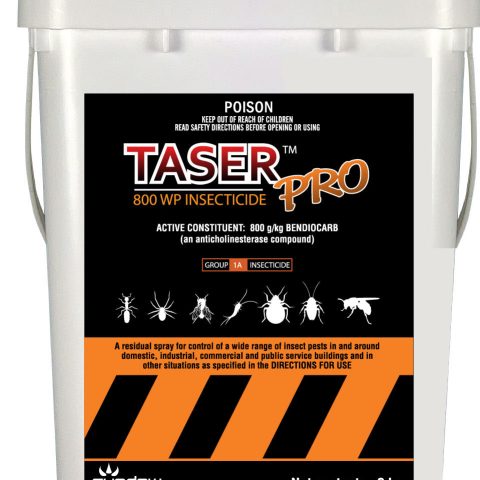
Ficam W is a residual spray insecticide for Pest Management Professionals. It controls a wide range of crawling and flying insects in and around domestic, industrial, commercial and public service buildings. Its active ingredient, bendiocarb, is a Group 1A carbamate, so it works differently from the pyrethroids most commonly used in general pest control.
It solves two common problems. First, its non-repellent action means insects don't detect and avoid treated surfaces. This helps with pests that avoid or scatter from repellent sprays, such as ants and bed bugs. Second, as a non-pyrethroid it gives Pest Management Professionals a rotation option to manage insecticide resistance.
The registered uses go well beyond indoor spraying. They also include European wasp nests, fly-resting surfaces, Black Portuguese millipede barriers, black beetle in turf, and treatment of pasture seed against seed harvesting ants.
Product Highlights
- Non-repellent carbamate: insects keep moving across treated surfaces instead of avoiding them, so more of them pick up a lethal dose. This matters most for ants, bed bugs and cockroaches that tend to avoid or scatter from repellent treatments.
- Built for resistance management: as a Group 1A insecticide, it can be rotated with Group 3A pyrethroids such as deltamethrin. This avoids relying on one mode of action against cockroach and other populations that may be resistant.
- Pre-measured 15 g sachets: each sachet matches the label's mixing unit. You don't need to weigh powder on site, which means less dust handling and more consistent mixes. The product disperses readily in the spray tank, is odourless, and its larger particle size helps residual activity on a range of surfaces.
Target pests
- Ants
- Bed bugs
- Carpet beetles
- Cockroaches: German, Oriental, American, Australian and smoky brown
- Fleas
- Spiders
- Silverfish
- Black Portuguese millipedes
- European wasps (Vespula germanica)
- Flies: common housefly, stable fly, brown blowfly, European green blowfly and lesser housefly
- Seed harvesting ants (Pheidole spp.): pasture seed treatment
- Black beetle (Heteronychus spp.) in turf: not registered in Tasmania
Where to use
- Food processing factories, restaurants, kitchens, canteens and food stores
- Hospitals, hotel-motels, laundries, boiler houses and ships
- Private dwellings, and in and around farm buildings
- Paths and external walls around buildings (millipede barrier)
- European wasp nests
- Walls, ceilings, fences, yards, animal houses, abattoirs, garbage containers and dumps, manure heaps, and other places where flies rest or breed
- Pasture seed, e.g. phalaris, lucerne, perennial ryegrass, fescue, subterranean clover and cocksfoot
- Turf: golf greens and fairways, bowling greens and playing fields (not Tasmania)
Application
Dilute with water and apply with hand-operated or power-operated sprayers. Mixing rates, volumes and coverage for each situation are on the label.
- Before use, wash out any sprayer that holds oily residues with water and detergent.
- Fill the sprayer with water, add Ficam W, then close and shake or stir thoroughly. Shake or re-agitate if spraying is interrupted.
- Apply as a coarse, low-pressure spray, just short of runoff, to surfaces, cracks and crevices where pests hide or live. Absorbent surfaces need higher rates.
- Re-treat 6 to 8 weeks later, or when pests reappear.
- Millipedes: spray paths and walls to a height of 1 m around buildings to prevent invasion.
- European wasp nests: inject spray into all nest openings, breaking down larger nests if needed for coverage. Treat at night whenever possible.
- Flies: apply as a sugar bait to all surfaces where flies may contact the spray deposits.
- Turf: apply in enough water for uniform coverage while adult black beetles are present (September to November, and late January to February).
- Seed treatment: coat seed with a slurry, e.g. in a cement mixer. For legume seed, mix in with the inoculum. Follow the label's handling, storage and four-week sowing limits for treated seed.
Safety
POISON (Schedule 6). Product and spray are poisonous if absorbed through the skin, inhaled or swallowed. Repeated minor exposure may have a cumulative poisoning effect. The product will irritate the skin.
- When opening the container and preparing spray, wear cotton overalls buttoned to the neck and wrist, a washable hat and elbow-length PVC gloves.
- Wear a disposable respirator when using in enclosed areas.
- For wasp nest treatment, wear clothing that protects against wasps: long-sleeved overalls buttoned at wrist and throat, gloves, hat and bee veil.
- Do not spray people or animals. Remove or cover food, dishes, utensils and food preparation areas before use.
- Dangerous to bees, fish and other aquatic organisms. Keep animals away from treated European wasp nests for 24 hours.
- Poisons Information Centre: 13 11 26.
- Dangerous goods: UN 2757, Class 6.1 (Toxic), PG II, HAZCHEM 2X.
FAQ
- Can I rotate Ficam W with my pyrethroid sprays? Yes. Ficam W is a Group 1A carbamate, a different mode of action from Group 3A pyrethroids such as deltamethrin, which makes it a practical rotation partner. Avoid using Ficam W or other Group 1A products repeatedly, because resistant insects can come to dominate a population.
- Will it leave a visible residue? It can. As a wettable powder, it may leave visible deposits on some glossy surfaces. Consider the surface before treating, especially in customer-facing or decorative areas. Absorbent surfaces also need higher rates to perform.
- Can I use it in food areas, bedrooms or homes with pets? Food premises, kitchens and dwellings are registered situations. You must remove or cover exposed food, utensils and food preparation areas first. Do not apply to mattresses, bedding, bedclothes or clothing. For bed bugs, treat bed frames and nearby cracks and crevices only. For fleas, treat floors and pet sleeping areas, but never the animals or their bedding. Do not spray surfaces animals can lick.
Pack Size
150 g box containing 10 × 15 g pre-measured sachets.
Approximate packed dimensions: 170 × 110 × 80 mm (about 0.2 kg).
- How to order: quote Garrards product code FI/150 (FICAM W 150G).