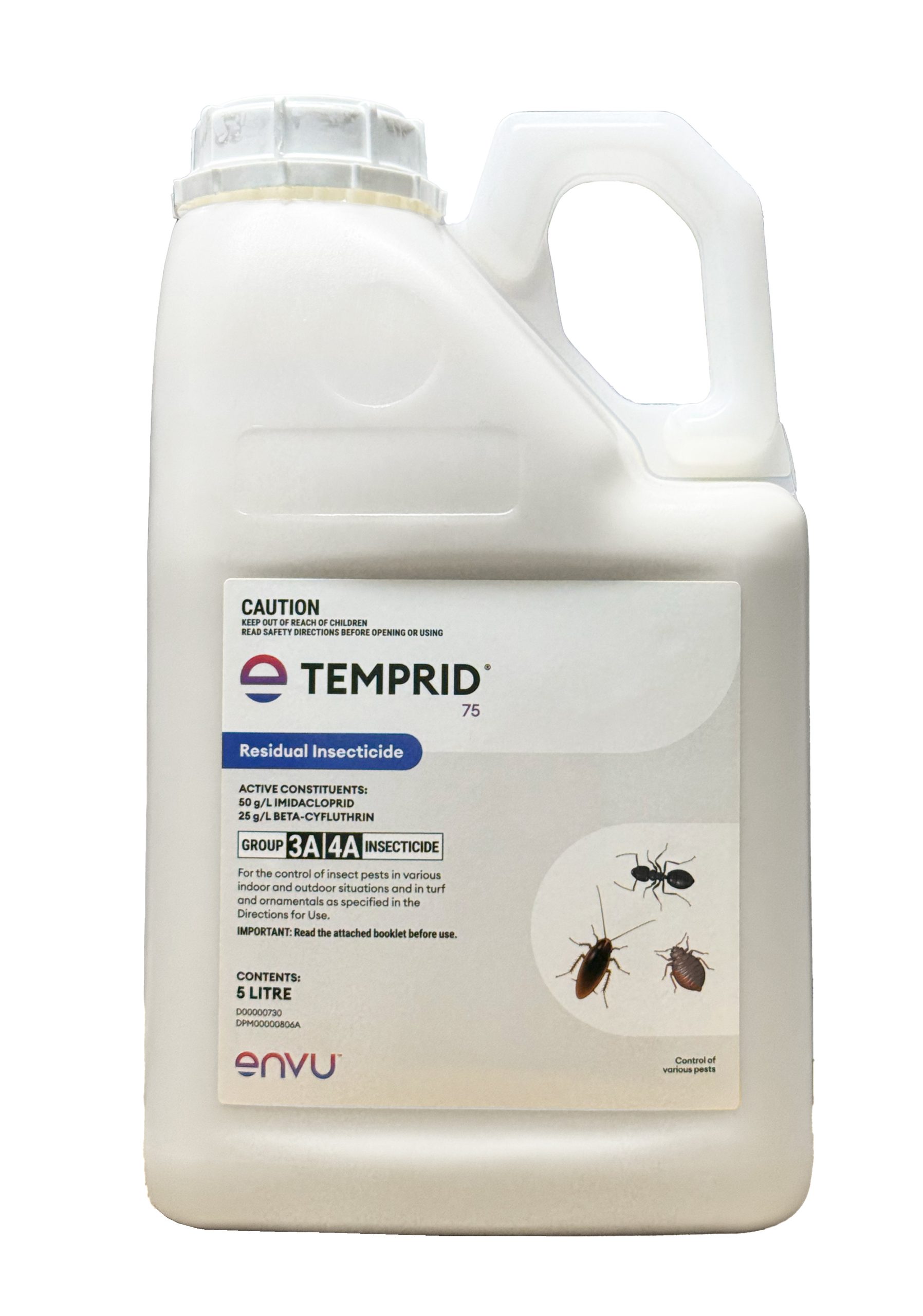
Product details
Formulation
Water-based suspension concentrate (SC), diluted in water before use.
- Insecticide mode of action groups: Group 3A (beta-cyfluthrin, a synthetic pyrethroid) and Group 4A (imidacloprid, a neonicotinoid)
- Poisons schedule: Schedule 5 (SUSMP)
Overview
Temprid® 75 Residual Insecticide is a professional general insecticide concentrate. It controls crawling and flying insects inside and around domestic, commercial, industrial and public buildings. It is also registered for insect pests in turf, lawns and ornamental plants. APVMA No. 64371/125306.
It combines two actives from different mode of action groups, so Pest Management Professionals get knockdown and a residual barrier from one product. This covers routine general pest services: ants, cockroaches, spiders, fleas, bed bugs, silverfish, stored product pests and flies. It can be used in perimeter barriers, crack-and-crevice work, void treatments, carpets and direct ant nest treatments.
The label also covers lawn, turf and ornamental pests. A Pest Management Professional can treat the building, the lawn and the garden beds on one job with one concentrate, rather than carrying separate products for each.
Product Highlights
- Two actives, two mode of action groups (3A + 4A): Envu says HAS technology makes the two actives work together (synergy). Having two groups also helps with resistance management, where repeated use of a single group is the risk.
- One concentrate for structures, turf and ornamentals: indoor, outdoor, perimeter, void, lawn and foliar uses are all on one label. That means fewer products to stock, carry and record.
- Flexible application: you can apply it to any surface that water alone won't damage, including carpets and rugs, wet areas (limited to harbourages, cracks and crevices that routine cleaning can't reach) and wall or structural voids. Equipment carried on the back is allowed, provided the label PPE is worn.
Target pests
Structural (indoor and outdoor):
- Ants
- Bed bugs
- Carpet beetles
- Clothes moths
- Cockroaches
- Crickets
- Fleas
- Millipedes (non-porous surfaces only)
- Flies, including house flies
- Mosquitoes
- Paper nest wasps
- Silverfish
- Skin and hide beetles
- Spiders (web-spinning and non-web-spinning)
- Stored product pests (beetles and moths)
- Ticks (not paralysis ticks)
- Turf and lawns: lawn armyworm, cutworm, webworm
- Turf and lawns: adult Argentine stem weevil, adult billbug, adult scarabs including African black beetle
- Turf and lawns: mole crickets, couch mite, ants, grasshoppers
- Turf and lawns (tank-mixed with MERIT® Turf and Ornamental Insecticide): first instar larvae of African black beetle, Argentinian scarab and pruinose scarab; billbug larvae
- Ornamentals: aphids; bugs such as passionvine hopper, mealybug and lace bug; caterpillars; garden weevil; whiteflies; thrips
- Ornamentals (tank-mixed with MERIT® Turf and Ornamental Insecticide): hibiscus flower beetle, longtailed mealybug, psyllids, soft scales
Where to use
- Internal and external areas and surrounds of domestic, commercial, industrial and public buildings, facilities and structures
- Includes aeroplanes, barracks, factories, farm buildings, food processing establishments, hospitals, hotels and backpacker accommodation, offices, private dwellings, schools, ships, shops, storerooms and trains
- Voids: behind veneers, piers and chimney bases, rubble foundations, block, wall and structural voids, under slabs and porches, and soil in crawl spaces
- Perimeters: building walls, door and window frames, eaves, and a band of soil, turf or ground cover next to the structure
- Tick treatments: building surrounds, untended verges and the surrounds of sporting venues
- Animal houses: do not spray livestock or their food, water, litter, feed bins or any surface stock can reach
- Turf and lawns (ground application only)
- Ornamental plants, including garden beds in ant management programs
Application
Dilute in water and apply as a coarse, directed surface spray, stopping before run-off. Dose rates and application volumes are on the label.
- Mixing: half-fill a clean sprayer with water, add the measured product, top up with water and agitate
- Equipment: any suitable hand-held or mechanical sprayer; equipment carried on the back is permitted
- Nozzles: flat fan for surfaces; pin-stream nozzle or crack-and-crevice extension for cracks and crevices
- Wall voids and enclosed cavities: adjust the nozzle to a fine mist to avoid run-off
- Carpets and rugs: broadcast spray in overlapping bands. Test an inconspicuous patch first and let treated carpet dry before use
- Ant nests: spray directly into nest entrances. Pre-wetting dry, sandy or water-repellent soil helps the spray penetrate
- Turf: ground-based equipment only; never by aircraft; no more than three applications per year
- Ornamentals: foliar spray to the undersides of leaves until evenly coated but not dripping. Test a few plants first
- Do not spray outdoors if heavy rain is expected within 48 hours or the area is about to be irrigated (unless the label directions say otherwise)
- For surface treatment only: do not use in foggers or other aerosol-generating devices
- Do not spray moving parts of machinery, electric motors or switchgear
Safety
CAUTION – Schedule 5 poison. Keep out of reach of children.
- PPE when mixing and spraying: cotton overalls buttoned to the neck and wrist (or equivalent clothing) and elbow-length chemical-resistant gloves
- Equipment carried on the back: also wear cotton overalls over normal clothing, buttoned to the neck and wrist, plus a washable hat
- May irritate the eyes and skin. Facial skin contact may cause temporary facial numbness. May cause an allergic skin reaction. Harmful if swallowed
- Re-entry: keep people out of treated areas until the spray has dried, unless they wear label-specified clothing and chemical-resistant gloves
- Dangerous to bees: do not spray plants in flower while bees are foraging
- Very toxic to aquatic life: cover fish tanks and do not contaminate wetlands or watercourses
- Toxic to beneficial arthropods: not compatible with IPM programs that use beneficial arthropods
- Do not graze treated turf or feed treated clippings to poultry or livestock
- Poisons Information Centre: 13 11 26
FAQ
- Can Temprid 75 be tank-mixed? Yes, with Starycide® Insect Growth Regulator and MERIT® Turf and Ornamental Insecticide. These are the compatibility partners named on the label. Starycide is recommended as an add-on for severe cockroach infestations, fleas and silverfish. MERIT is part of the registered mixes for scarab and billbug larvae in turf and for some ornamental pests. Where indoor ant or cockroach work doesn't suit a spray, the label suggests a registered bait or gel (e.g. Maxforce®) applied separately.
- Will it control pyrethroid-resistant bed bugs? Only through direct contact. For resistant strains, control depends on spraying the insects directly, not on the residual. Pest Management Professionals are expected to follow the AEPMA Code of Practice for bed bugs, inspect thoroughly, combine with non-chemical methods and re-inspect. Mattress edges and seams may be treated, but never the flat sleeping surfaces, bed linen or cots where infants sleep.
- Can it be used in food premises and on sensitive surfaces? Yes, food processing establishments are a listed situation, with restrictions. Remove or cover exposed food, utensils and food preparation surfaces, ventilate afterwards and clean up before service resumes. Don't let spray contact food packaging. Water-based spray can mark carpets, delicate fabrics and timber that will later be stained, so test first and warn the owner about timber. Residual sprays only kill flying insects that land on treated surfaces, so flies or mosquitoes moving in from untreated areas may still be seen.
Pack Size
5 L bottle. The Temprid 75 range also comes in 1 L.
- How to order: Garrards product code 823:TEMP75/5 (TEMPRID 5LT)